Olympus has announced a new digital PEN camera, the Olympus E-P2 (available for pre-order at Amazon). The major differences from the E-P1 are as follows:
- Ability to use a new, high resolution add-on EVF
- Black paint color under a glass coat
The Olympus add-on EVF looks to be a good bit larger than the GF1 add-on EVF, but based on specifications and early user reports, the added size comes with significantly improved resolution and quality. Here is a size comparison of the E-P2, GF1, and G1 approximately to scale:
Availability of the E-P2 has been reported as December or January.
Two new lenses were also announced and should be available in the first half of 2010:
- M.ZUIKO DIGITAL ED 9-18mm F4.0-5.6
- M.ZUIKO DIGITAL ED 14-150mm F4.0-5.6
As noted above, the E-P2 is already available for
pre-order at Amazon
Additional images:
Read More......
The default noise reduction implementation in Adobe Lightroom has dramatically changed with the Adobe Lightroom 3 beta. High ISO rendering in the Lightroom 3 beta now resembles that of Raw Developer or Capture One more than it resembles that of Lightroom 2.
Here's an example using two 100% crops from an ISO 1600, 1/4s, f/5.5, 48mm image I took this weekend with the Panasonic GH1 and kit zoom in low light. On the left is the default LR2 conversion, on the right the default LR3 beta conversion:
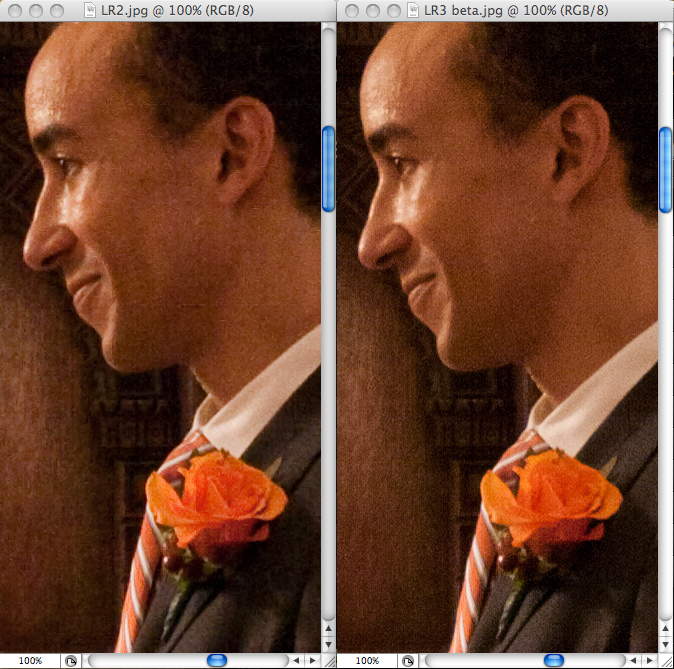
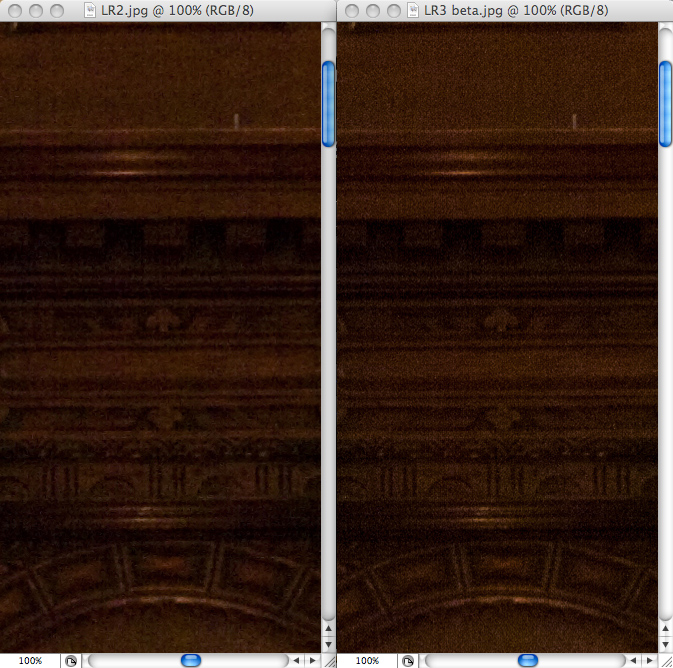
The change is, to my eye, a significant improvement. For the first time, I am considering Adobe Lightroom as a first line RAW processing application.
Read More......
by Mayank Bhatnagar
As a graphic designer, I often design for organizations including non-governmental organizations working in the development sector and frequently receive images from clients for use in communication material as varied as brochures, websites, flyers, annual reports, newsletters, fact sheets and technical documents. I am fond of the imagery the development sector uses and often find it more interesting and natural than the slick, perfect and utopian imagery used by the marketing (fast moving consumer goods) and now information technology sectors.
In the past couple of years, for dozens of design assignments undertaken for development sector clients, I have rarely received 'technically perfect' images shot by professional photographers using high end equipment such as dSLRs. Most images I receive have been shot by clients / volunteers / students using compact cameras. And by compact cameras here I mean the most basic or budget compact cameras running on 'auto' mode. Noise, highlight clipping, channel clipping, colored fringing, blooming of highlights, poor dynamic range, excessive use of flash (and therefore harsh shadows) and color cast are just some of the technical issues I frequently encounter while shortlisting and processing the images for print and/or web publishing.
For a large design assignment, I typically receive an assortment of images (usually about two dozen or more) which are then categorized to match with text / report chapters / sections. Unless the technical quality of a particular image is unacceptable, I am forced to make do with what I have and each relevant image is then optimized for print. Thanks to powerful image processing software, each selected image usually goes through the following process:
- Resizing (usually downsizing), size of technically bad or blurred but important photos is usually reduced greatly, sometimes as small as 2x1 inches, to make them useable and hide some of the flaws. I prefer to convert images to 240 ppi resolution for print purposes.
- Noise reduction (usually applied to full-size images which are later downsized).
- Shadow and highlight recovery (using shadow-highlight sliders in Photoshop), adjustment of levels. Sometimes HDR techniques are used to process different parts of the image separately.
- Correction of color cast.
- Correction of horizontal plane, also barrel distortion and perspective in some cases.
- Correction of skin tones (often flashed faces come out reddish and are not easy to correct)
- Conversion to CMYK (for 4 color printing) or to Greyscale for one or two color printing.
Usually cropping decisions are taken at the page markup stage where I can see the image-text relationship accurately and crop images accordingly.
Images are almost always received as a part of the brief and for most development sector design assignments (with tight budgets), buying stock imagery or getting a professional shoot done is not an option. I think most reasonable :-) graphic designers learn to work under constraints and make do with what they are given.
As someone also doing serious and fine art photography with compacts for the past couple of years, this is where I fall into a dilemma. While on one hand I strive to capture technically sound images and am always on the lookout for the next compact that would raise the bar on my images, on the other hand as a designer I make do with images that I would reject outright for technical flaws if taken by me. Images used in important publications, which may be read and used by top national and international organizations, governmental agencies, funding agencies, think tanks and the like, taken with automatic point-and-shoot cameras I would not even look at! Thus I wonder if it is the image (the subject, the moment, the interrelationship of elements, the light, etc.) and the purpose for which it was taken that really matters and that the rest is essentially 'technical' and 'secondary', the bit photographers tend to worry too much about these days! Also, as someone who worked extensively with film / transparency scans uptill 3-4 years back, it feels great to receive compact digital camera images because they are far easier to process than traditional (drum or flatbed) scans and thankfully file sizes are much lighter!
One change I have noticed over the past couple of years with regard to imagery supplied by clients (for use in communication design) is that the 'number' of images coming in has increased dramatically and organizations that could earlier not afford expensive imagery or visual documentation of their projects now have enough 'workable' photos in their database. For this, a lot of credit should probably go to the recent boom in affordable, pocketable and easy-to-use compact cameras, which in my humble opinion, are making a big difference for organizations involved in development work and perhaps indirectly in the lives of people for whom they are working.
__________________________________________________________________________________
Mayank Bhatnagar is a Jaipur and New Delhi (India) based graphic designer, illustrator and photographer.
Read More......
Serious Compacts contributer Wouter Brandsma asks:
How come so many photographers are so obsessed with the newest camera, the latest feature? Why does it matter what camera was used for a photograph?
Read Wouter's thoughts and join the conversation at
Wouter Brandsma Photography.
Read More......