By Wouter Brandsma
While Amin is working on a Ricoh GR Digital III test sample and comparing it with other cameras I received a test sample from Ricoh Europe. My aim is to come up with a similar written impression of this camera like I did with the GX100 and the GX200. I will post a more lengthly impression of the new Ricoh GR Digital III soon, but I thought it wouldn’t harm to write down some first impressions of this camera.
I always thought that my Ricoh GX200 felt like a quality camera, well to be honest it still is, but the GRD is certainly a step beyond that. The camera has a lovely, quality feel with a nice non-slippery finish as a result of the magnesium body. The camera has the typical Ricoh handgrip and all buttons are logically placed, almost logical in fact, but more about that later.
I have never had any other Ricoh GR Digital camera although I have certainly considered it. Eventually I chose the Ricoh GX100 in 2007, because of the stepped zoom lens. Making it slightly more versatile. I still think I should have followed my heart and should have picked up the GR Digital I though. So remember this! Even though many consider reviews by professional reviewers the bench mark for the scientific proof of the quality of a camera, I have learned to be completely in rational with regard to deciding cameras. In the end you are going to take the pictures with it and you will use and push the camera beyond the brick walls and color charts at different ISO's. Real world is totally different in my opinion.
I still have the original GR camera though, the Ricoh GR1 which became a true cult camera, in particular in Japan. The most distinctive features of the GR series are the lightweight magnesium body, a high class 28mm lens and easy to use handling. And to me, the Ricoh GR Digital III forms no exception.
From the outside the camera hardly differs from the other GR Digitals. It is only a bit larger to host the slightly larger sensor. And on the rear you will notice the larger 3" LCD screen with 920,000 dots. Also this third generation GR Digital has no optical viewfinder. Now some say that we should live with that. A fact of life for small compact cameras, but I much rather prefer a smaller LCD screen and a little increase in camera body height to accommodate a nice bright viewfinder. But I guess I am old school. Therefore I requested Ricoh to supply the camera with an optical viewfinder. I asked for the GV-1 viewfinder which is quite large and not only has the frame lines for 28mm, but also for 21mm to match the view with the GW-2 21mm Wide Conversion Lens. Probably due to huge demand in Japan Ricoh doesn't have the wide conversion lens in stock now, but I hope I will get before I finished testing this camera.
While mentioning the supply difficulties of the GW-2 I should mention too that Ricoh was completely surprised by the pre-sales in Japan. These were much larger than anticipated and was part too of the reason to offset the sale date basically everywhere else. The camera is now on sale pretty much anywhere, although I haven't seen this camera available in the Netherlands, where I live, yet (mid September).
Like Panasonic with the LX3 and Canon with the new G11 Ricoh was able to get a new sensor that has less pixels than the previous version. In combination with the better in-camera image engine and the fast lens, this will improve the low light capabilities and high ISO performance. This is an important change in the market of serious compacts and I hope it will be followed by others. But what makes this camera unlike any other compact camera is the new 28mm lens with a maximum opening of f/1.9. It used to be f/2.4 (thank you Fabian)! An outstanding technical achievement in my opinion.
So, before this short impression ends up being a longer impression I will sum up some of my likes and dislikes with the new Ricoh GR Digital III.
Likes
Overall speaking I really like this camera. The feel and the handling makes it very special. In combination with the large and bright GV-1 viewfinder it is a joy to use. I can fully understand why the pre-sales where so high in Japan. Using this camera reminds me picking up the GR1 for the first time when I got it to replace my SLR. For me it still is a cult camera with all the subjective feelings that contribute for me to that status.
The best of all is the new lens. Such a fast lens is a bonus for low light and with the better high ISO performance I have had no problems using this camera at higher ISO's, even up to ISO 1600. That is something I never did with the GX200, because of all the noise and banding.
Dislikes
There is no perfection in my opinion and also the GRDIII reminds me of that. Quality comes at a price and Amazon prices the GRDIII for $699. That sure is a lot of money in my opinion, but it is a cult camera with superb built quality, top materials, and a stellar lens. While some love the new 3" LCD screen, because they only photograph with the LCD screen. It is just too large for me. To get such a large sensor in the body they had to move the buttons further to the right rear section of the camera. Although they glad fully didn't change the button lay-out I regularly hit the display and macro button with my right thumb. Something that never happens to me with the GX200.
I leave it for here and will continue evaluating this camera for some time. I hope to post my final impressions of this camera by the end of this month. Interested to read more about this camera? You might want to check out the Ricoh site.
All photographs by Wouter Brandsma
Short Ricoh GR Digital 3 impression
Monday, September 14, 2009
Posted by Wouter Brandsma
Comments
 Labels:
impression,
Ricoh,
Ricoh GRDIII
Labels:
impression,
Ricoh,
Ricoh GRDIII
2010 Micro Four Thirds Lens Roadmap: What's Missing?
Sunday, September 13, 2009
With any new system, it is impossible to cover all lens needs right away. Thus manufacturers need to prioritize according to commonly used lens types and market demand.
Here's what we have so far for Micro Four Thirds:
Ultra-wide:
- Lumix 7-14mm f/4 (difficult to locate in United States)
- Lumix 8mm f/3.5 (fisheye, due in 2010)
- M. Zuiko 17mm f/2.8
- Lumix 14mm f/2.8 (due in 2010)
- Lumix 20mm f/1.7 (due soon)
- M. Zuiko 14-42mm f/3.5-5.6
- Lumix 14-45mm f/3.5-5.6 O.I.S.
- Lumix HD 14-140mm f/4-5.8 O.I.S.
- Lumix 45-200mm f/4-5.6 O.I.S.
- Lumix 100-300mm f/4-5.6 O.I.S.
- Leica DG Macro-Elmarit 45mm f/2.8 O.I.S. (1:1 macro, due soon)
What I'd like to see is a high quality optic with the following characteristics:
- Fixed focal length between 37.5mm and 67.5mm
- At least f/1.8 speed and preferably f/1.4
- Quick autofocus
Posted by Amin
Comments
Sigma DP2 Shootout Pt. 1 - Form and Function
Saturday, September 12, 2009
Size
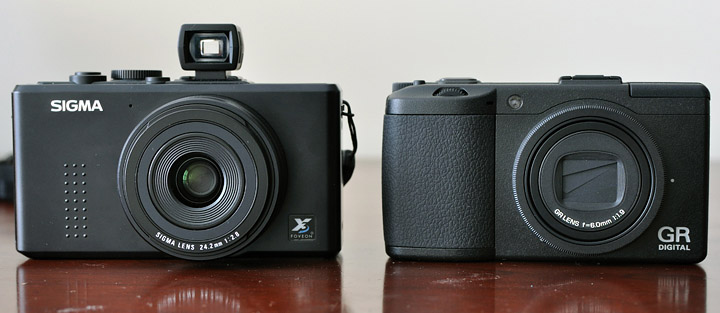
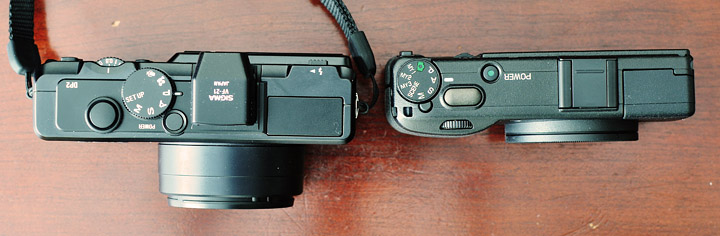
Sigma created the category of large-sensor compact camera and presently remain the only company with a fixed lens large-sensor camera on the market. Amongst all current large-sensor cameras, the DP2 is the second most compact, closely following the DP1.
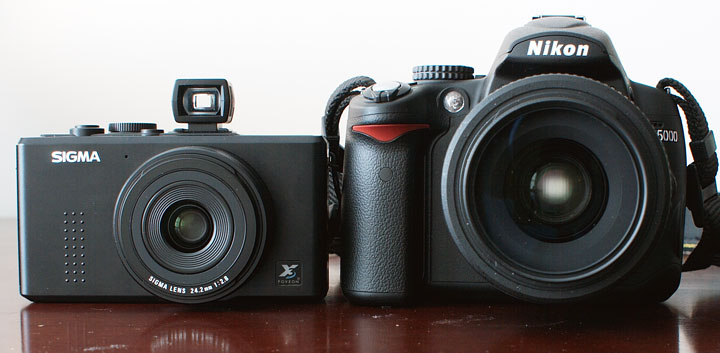
In contrast to any Micro 4/3 camera-lens combo, a DP2 without hood or accessory optical viewfinder (OVF) will fit in a standard pants pocket. However, the DP2 is no shirt pocket camera.
Here's how the DP2 compares in size and shape with an advanced small sensor compact, the Ricoh GR Digital (GRD) III:
Compared to the Panasonic GH1 and M. Zuiko 17mm f/2.8:
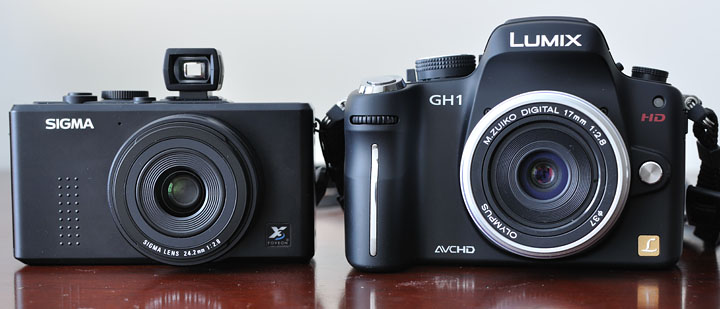
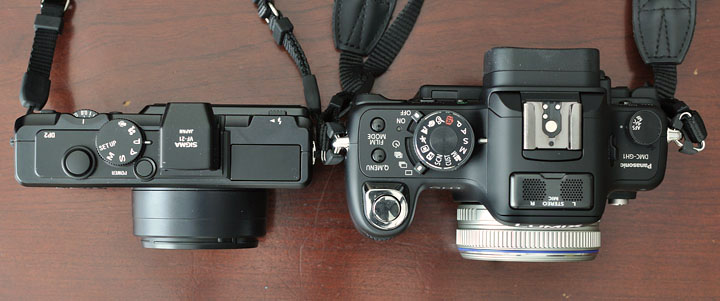
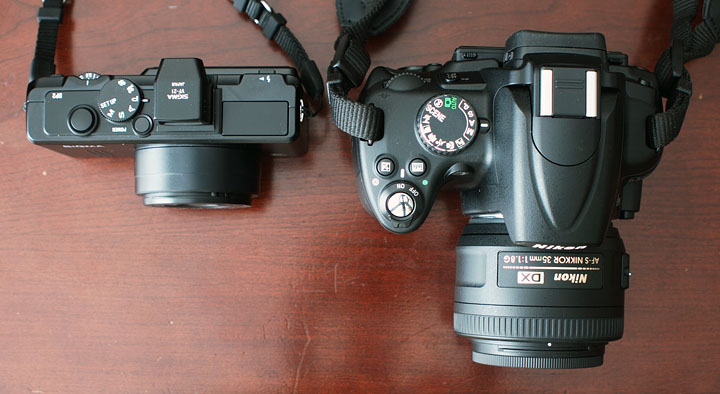
Keep in mind that the DP2 sensor is intermediate in size between that of a Micro 4/3 camera and that of a 1.5x crop APS-C camera such as that of Samsung NX or Nikon APS-C.
Lets see how the DP2 compares in size to a small Nikon APS-C rig:
Build quality
The Sigma DP2 is extremely light when compared to any Micro Four Thirds combination and featherweight in comparison to any DSLR gear. This has led a number of observers to state that it feels "cheap". Likely the nondescript looks also contribute to this assessment. In contrast, I appreciate the lack of weight hanging around my neck and don't find anything wanting in the DP2 build quality. There is no give or creak in the DP2 body. Dials, controls, and battery door are all solid. Accessories such as the optional OVF and hood snap are likewise nicely fitted.
Look and sound
With regards to looks, Sigma has chosen a serious and discreet appearance. I'd prefer something with a bit more flair, but many will prefer the staid DP.
Like the DP1, the DP2 makes an unpleasant noise when extending the lens and is a bit noisier than I'd like when autofocusing. The shutter click is very quiet and unlikely to be noticed.
Controls and usability
The DP2 is boxy, but I find it very comfortable to grip and use for an extended period. Controls are well designed though not outstanding. Compare to the recently announced Leica X1 (images carefully resized to proper scale):
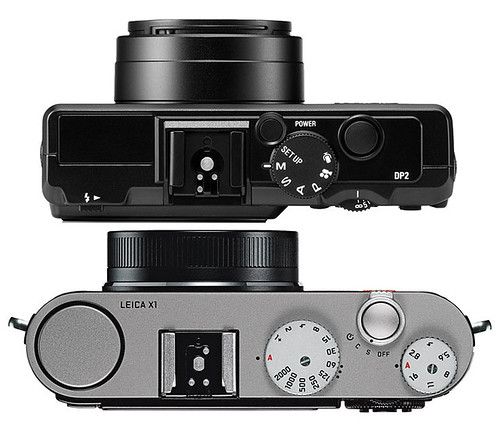
To give the DP2 its due, the primary apparent exposure parameters - aperture, shutter speed, and ISO - are all readily available during use of the camera, which is more than I can say for a number of serious compacts. In manual exposure mode, the rocker switch controls shutter speed which the left/right buttons (on the four way controller) determine aperture settings. In aperture priority mode, the rocker controls aperture, and left/right controls exposure compensation. The 'QS' button gives rapid access to ISO control. Simple and effective. One niggle is that auto ISO will select only from ISO 100-400. I would prefer to be able to choose the top ISO as is possible on the GH1 and D5000.
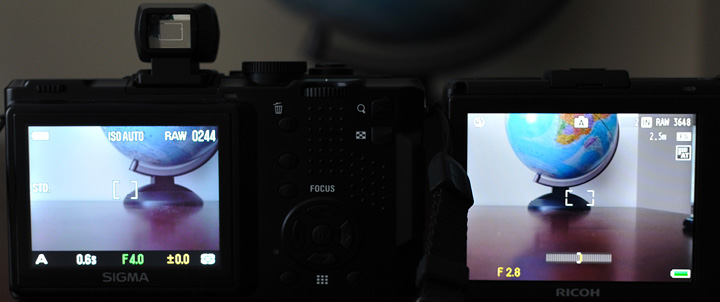
The LCD display, widely criticized with the DP1, remains below average for a camera of this class. It's not a show stopper for me, but a better LCD would be welcome. Here you can see the LCD of the DP1 (left) compared with that of the GRD III (right) with both at their default brightness:
Operational speed
Autofocus remains on the slow side, slower than that of the GH1 with M. Zuiko 17mm lens (which itself doesn't focus as quickly as the G1 kit zoom) and slower also than the GRD III. The DP2 focus also struggles more in low light than those other two cameras. That said, the DP2 focus is accurate and is quicker when one limits the focus range to farther distances by selecting the landscape focus mode. As with the DP1, a focus confirmation light is visible without removing one's eye from the OVF.
Manual focus is well implemented. I prefer the DP2 focus wheel to the manual focus implementation on the GH1 or GRD III because there is a visible, palpable control by which one can reliably scale focus at medium and small aperture settings.
Pressing the 'OK' button (with the latest firmware) gives a magnified view for manual focus. I'd prefer if Sigma would have the display automatically present a magnified view whenever the manual focus dial is turned, as is the case by default with the GH1. However the current DP2 implementation is very good.
The buffer has been improved from that of the DP1. One can now take photos in RAW with a shot-to-shot time of approximately 2.5 seconds, which is short enough for me although a two shot buffer without waiting would be even better.
In Part 2 of this shootout-based review, we'll take a look at lens performance.
Posted by Amin
Comments
Update on the Sigma DP2 - Olympus E-P1 Shootout
Friday, September 11, 2009
As some of you know, Sigma has been kind enough to loan me a DP2 for some time now. The DP series is truly unique with only the recently announced Leica X1 presenting a similarly specified competitor in this class.
I had hoped to obtain an Olympus E-P1 and 17mm kit for a direct shootout with the Sigma DP2, and Olympus had assured me that I would have a kit available by the end of August. Unfortunately they don't yet have one for us, and I don't want to keep folks waiting any longer. Therefore I'll be doing a shootout based review of the Sigma DP2 using other cameras for comparison, namely the Panasonic GH1 with M. Zuiko 17/2.8, Ricoh GRD III, and Nikon D5000. If I can get an Canon S90 before the GRD III has to go back to Japan, I'll do a separate shootout between those two exciting compacts.
Posted by Amin
Comments
E-P1 - GH1 Size Comparison
Thursday, September 10, 2009
A few days ago, I posted some comparisons between carefully scaled pictures of the GH1 and GF1 which I found helpful in choosing which Micro Four Thirds camera to buy.
Today I went to my local camera store to pick up an Olympus M. Zuiko 17mm f/2.8 (for use on the GH1 in the upcoming Sigma DP2 shootout) and took the opportunity to snap a couple comparison shots of the GH1 and E-P1.


The 17mm Zuiko lens transforms the GH1 into a remarkably small and light camera. Read More......
Posted by Amin
Comments