Number 2 is the Canon Powershot G10.
The Canon Powershot G7 was brought forth in 2006 as the long-awaited replacement for the G6. Yet, in several key ways, the G7 broke ranks with the models which preceded it. Gone was RAW, the articulated LCD, and the fast, f/2.0-3.0 (35-140mm equivalent) lens from the G3, G5, and G6. Rather than a follow-up to the G6, the G7 was the heir to the Powershot S80.
Canon G fans protested loudly, but with the exception of reintroducing RAW with the G9, Canon has stuck to its path. The days of the chunkier G are gone, and Canon has continued to refine the model it brought forth with the G7. With the G10, it seems as though they have come very close to perfecting the formula.
Here's a quick look at some of what the G10 offers:
- 28-140mm (equivalent) f/2.8-4.5 lens with excellent sharpness across the frame
- Relatively low distortion
- Best in class resolution
- Excellent noise performance
- Best lens speed amongst current compact telephoto offerings
- Amongst the best available controls in a compact with easy to use menus and dials for ISO and exposure compensation
- Responsive performance
- RAW
- Best in class image stabilization (based on my subjective impression)
- Best in class LCD quality
- Useful optical viewfinder
- Hot shoe
- Great build quality and ergonomics
- Good battery life
- Large feature set
There is little to fault with the G10. Two things to consider are that it is less pocketable than some of the alternatives and that it has average dynamic range for class.
Overall, I believe that the Canon G10 is perhaps the single best choice for the majority of photographers seeking an advanced compact camera for general use.
The Canon G10 currently
sells for $440 at Amazon
Number 1 tomorrow. Preview: There is a tie for #1.
Read More......
Posted by Amin
 Labels:
Canon G10,
top ten
In Part 4 of the shootout, we'll look at the Canon G10 and Leica D-LUX 4 (Panasonic LX3) performance in low light at different ISO settings. Two things should be considered in this comparison:
- The D-LUX lens is about 2/3 stop faster at any given angle of view, so comparing the two cameras at the same ISO may not reflect the real life situation, where one is likely to need a higher ISO with the G10 than with the D-LUX.
- DxOmark found an approximate one stop disparity between the measured and reported (manufacturer) ISO at any given setting on the LX3, a disparity that they did not find with the G10. In other words, according to DxOmark, what the LX3 reports as ISO 400 is really ISO 200, 800 is really 400, etc. Click here to see their results. According to those data, we should really be comparing manufacturer ISO 400 LX3 files with manufacturer ISO 200 G10 files (statement edited after correction in comments), and so forth. However, shooting both cameras with manually matched exposure settings (f-number and shutter speed) and the same reported ISO resulted in the same resulting apparent exposure. Thus, assuming that 1) neither manufacturer is misrepresenting the shutter speed and/or aperture setting, and 2) that DxOmark is correct in their sensor analysis, it follows that somewhere in the processing pipeline, the LX3 data is getting pushed to the appropriate exposure index. Therefore, the assumption in the following comparisons is that, for practical purposes, the D-LUX 4 reported ISOs are accurate.
Methods:
- F-stop, shutter speed, and ISO were manually set identically for both cameras.
- The D-LUX 4 was used at approximately 35mm equivalent field of view (according to the in-camera JPEG, which means that the RAW data is slightly wider) and 4:3 aspect ratio to match the field of view of the G10.
- All files were processed in Raw Developer (Iridient Digital) with custom white balance, sharpening disabled, noise reduction disabled, and otherwise default settings.
- A single, sunlight balanced lamp was used to provide lighting.
- G10 files were downsized using Photoshop Bicubic to match the native size of the D-LUX 4 files.
100% crop comparisons are shown below. In each comparison, the G10 crop is on the left and the D-LUX 4 crop on the right.


I'd say the D-LUX 4 has a slightly better showing at high ISO in these comparisons, but there isn't much in it. However, taking into account both the faster lens and the slightly better sensor performance, the D-LUX 4/LX3 gives one about a one stop advantage over the G10 in low light. Bottom line: In typical use, I noticed a higher percentage of low light keepers with the D-LUX 4 than with the G10.
You can download all the RAW files below. There are five zip files:
Leica-1.zip contains ISO 80, 100, and 200 D-LUX 4 files.
Leica-2.zip has ISO 400, 800, and 1600 D-LUX 4 files.
Canon-1.zip has ISO 80 and 100 G10 files.
Canon-2.zip has ISO 200 and 400 G10 files.
Canon-3.zip has ISO 800 and 1600 G10 files.
Read More......
Posted by Amin
Labels:
Canon G10,
high ISO,
Leica D-LUX 4,
noise,
Panasonic LX3
My Canon G10 arrived yesterday, and one of the first questions I set out to answer was how it would compare to the Leica D-LUX 4 (Panasonic LX3) at high ISO. Panasonic, widely praised for stepping out of the megapixel race by keeping the LX3 at 10MP, claims that the benefits of large pixels include greater dynamic range and lower noise at high ISO. Based on samples at The Imaging Resource and elsewhere, most seem to agree that the LX3 in-camera JPEGs outclass the G10 in-camera JPEGs at high ISO. However, those who have seen the shootouts on this site know that I am mostly interested in comparing processed RAW files rather than in-camera JPEGs.
In the case of the G10 and LX3, comparisons of processed RAWs are limited by sparse third party support for the RAW files of these two cameras. In this comparison, I've chosen to use Raw Photo Processor (RPP), which uses a modified version of dcraw. RPP is good for this comparison in that it does not apply any sharpening besides that which is inherent in the demosaic process, nor does it apply any noise reduction when that option is disabled. Thus, it's about as close to the RAW data as I can get while presenting a color image comparison for your evaluation. The downside to RPP is that it does not technically support the D-LUX 4 yet, so the black level and colors needed adjustment. Overall, I tried to approximate the black level, white level, and color between the two processed files. The exposure for each photo was the same: f/4, 1/15s. Both cameras were set ISO 800, a 28mm equivalent angle of view, and 4:3 aspect ratio. The LX3 angle of view came out slightly wider. A tripod was used with self timer and image stabilization disabled. After processing the RAW files, the resulting G10 image was downsized using Photoshop Bicubic to match the LX3 file dimension for crop comparisons.
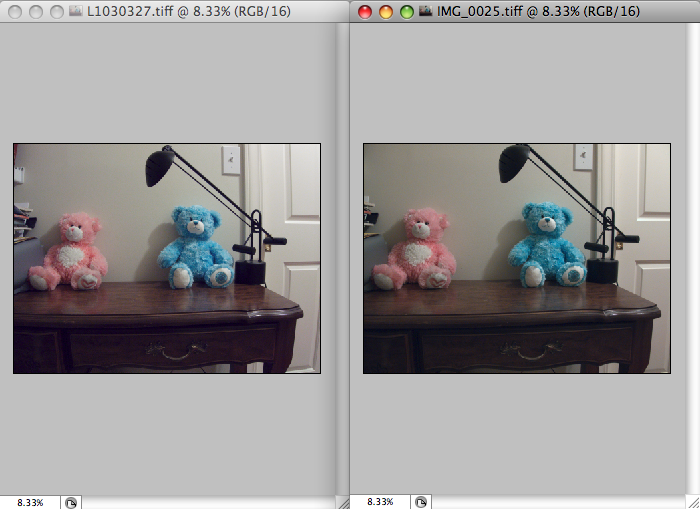
Pardon the choice of teddy bear test scene, but I was experimenting with a "1 Bear under the lamp" system for comparing dynamic range =). Here is the overall scene, with the LX3 resized image on the left, and the G10 resized image on the right:
In each of the following 100% crop comparisons, the G10 crop on the right has been downsized to match the output size of the LX3 crop on the left. Differences in color and contrast are due to the RAW processor (and my use thereof) and are not indicative of significant characteristics of these two cameras.
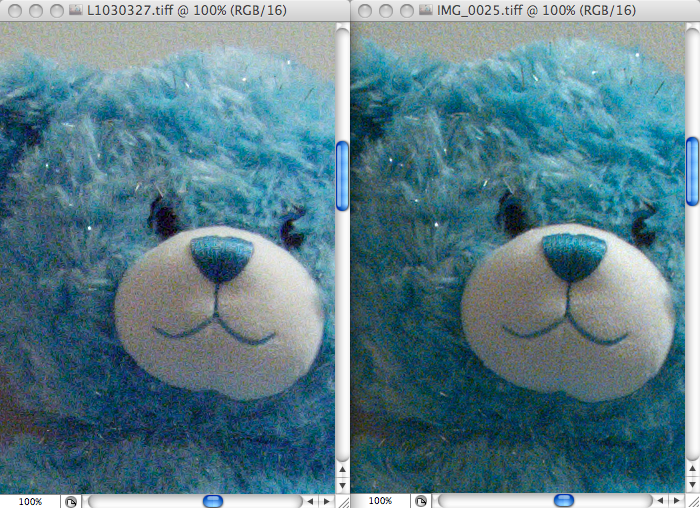

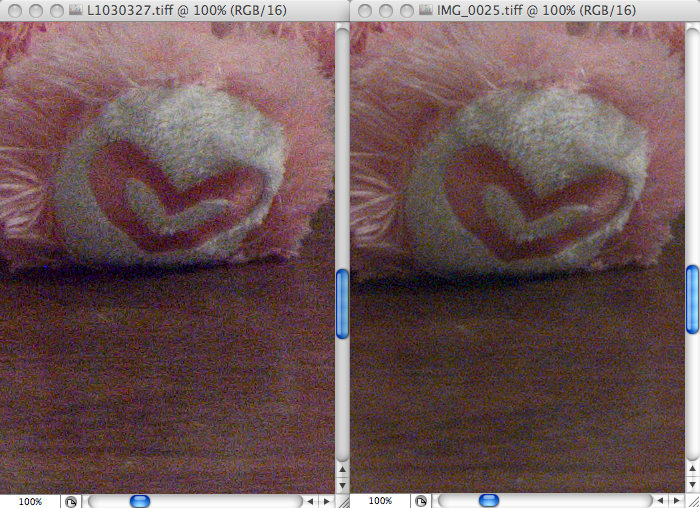
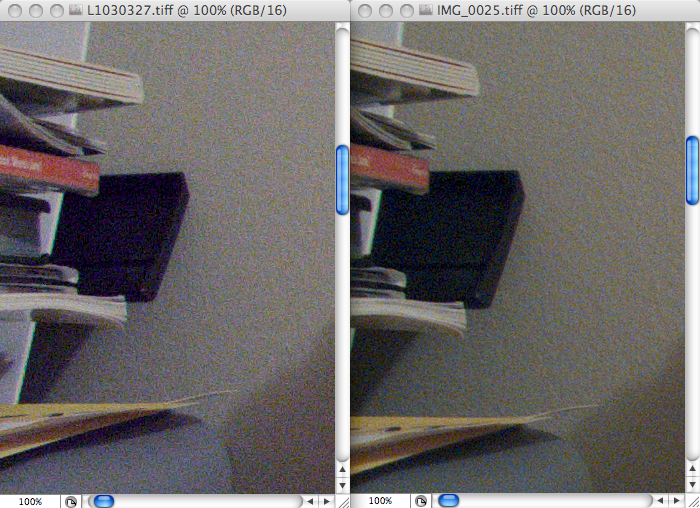
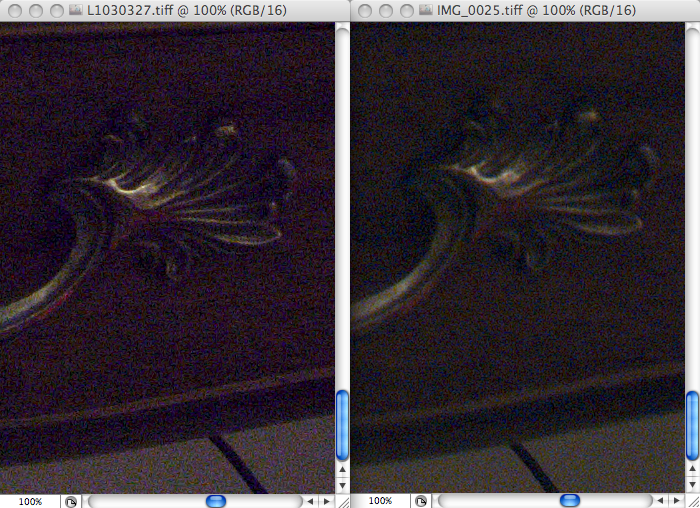

I was surprised to find that there is little difference in either detail or noise between the LX3 and G10 at ISO 800 under these testing conditions. Both files respond very well to subsequent chroma noise removal in Noise Ninja. The RAW files are here in case anyone would like to process them differently:
This is just one preliminary example, but assuming that other examples show the same - that a downsized G10 RAW conversion can match an LX3 RAW conversion at high ISO - then it raises the question as to whether the LX3 is really a better low light camera. The following table shows the minimum f-stop (max relative aperture) at any given focal length and corresponding focal length equivalent for these two cameras:

As you can see, the LX3 has a roughly 2/3 stop speed advantage at any given focal length equivalent. The other thing to consider is which camera has the more effective image stabilization. In comparing the D-LUX 2 (LX1) and G7, I felt that the G7 had the more effective stabilization. The LX3 seems to me to have better stabilization than the LX1, but I don't have a sense yet for how it compares to the G10 in this respect.
Overall, I'd have to say that the LX3 is probably the low light champ, especially with regards to in-camera JPEGs, but the G10 is surprisingly good at high ISO.
Read More......
Posted by Amin
Labels:
Canon G10,
G10-LX3 Shootout,
Panasonic LX3
Nikon expert Thom Hogan has posted an interesting comparison of the Canon G10, Panasonic LX3, and Nikon P6000. As usual, Thom has done an excellent job with the testing and analysis.
One correction: Thom says "The 16:9 aspect ratio is a love it or hate it thing. If you don't love it, this is not the camera for you, as you'll be leaving pixels on the floor and the camera suddenly doesn't have enough pixels to do more than smallish output." This is not true. In fact, the camera uses less total pixels in 16:9 than it uses in 3:2 or 4:3 aspect ratios. The reason for this is explained and illustrated here.
Thom's high ISO results and conclusions are interesting and somewhat surprising. I have a G10 on the way and look forward to testing it against the LX3/D-LUX 4.
Link: bythom - The Coolpix, PowerShot, Lumix Challenge
[Thanks Ted J]
Read More......
Posted by Amin
Labels:
Canon G10,
Nikon P6000,
Panasonic LX3
Arne Hvaring posted the following commentary and photos in a discussion which took place today in the GetDPI forums. We were discussing Michael Reichmann's G10-P6000 comparison on The Luminous Landscape (mentioned earlier today on the blog):
Here are a few things MR didn't tell you :)
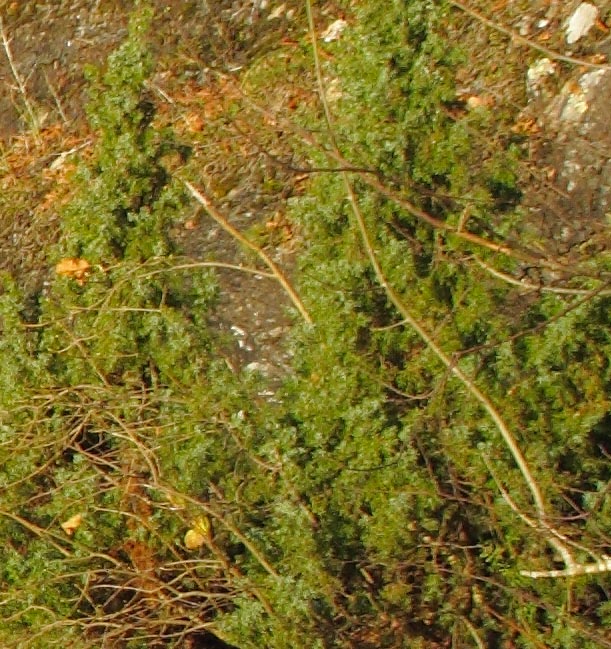
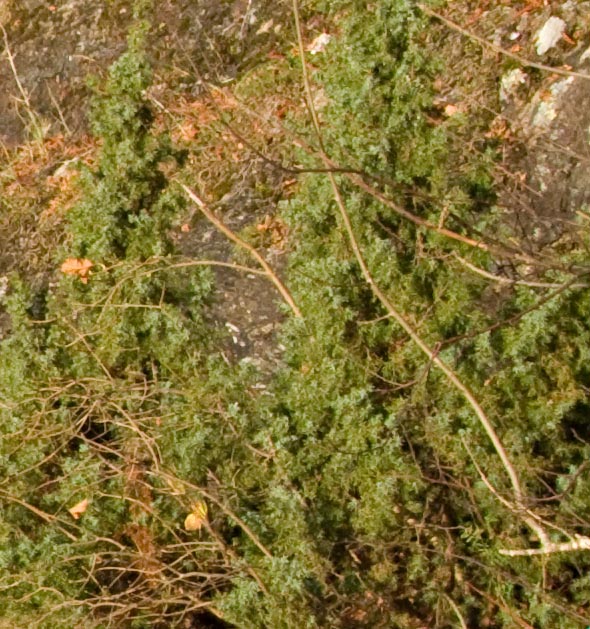
The DPP RAW conversion of G10 files introduces significant and sometimes rather bizarre artefacts. In default mode it also seems to sharpen the image to such an extent that any further sharpening looks overdone. MR uses "another RAW converter" which might be better, but officially DPP is the only game in town at the moment. The files of P6000 converted in ACR looks rather soft in comparison, but have much less demosaicing artefacts. The Nikon files can be PP significantly and sharpened a lot before becoming ugly.
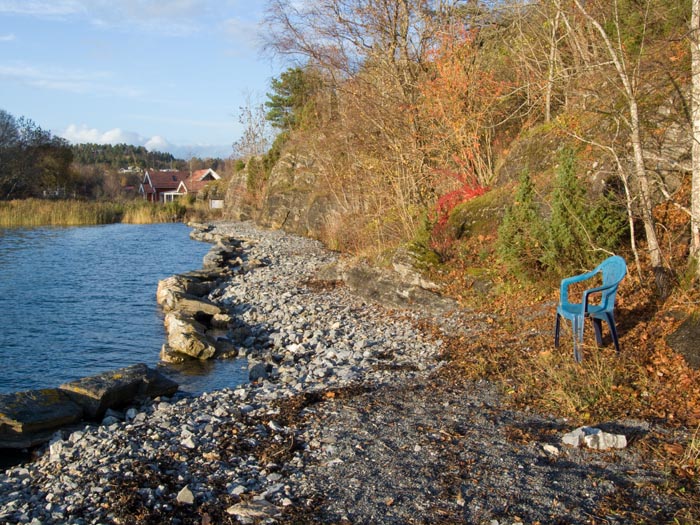
Below you'll see the full image, then 100% crops first from G10, then P6000. The crop is taken quite a bit from the edge of the picture and yet also the sharpness degradation (actually in the form of doubling of contours) of the Canon lens can be seen. But mainly the crops show the curious mess DPP/G10 makes of the green bush. The P6000 file is sharpened moderately and looks to me more natural and 3-dimensional.
The next two crops (Canon first) are from a more central part of the same image. While the Canon shows slightly more fine-detail resolution, it comes at a price. The diagonals (white wooden boards a.o.) have rather rough stair pixelling, and the tiles show much the same. The Nikon is more well behaved and looks smoother and more natural. The good news for G10 users is that most of these artifacts are not really visible in print, even up to A3+.
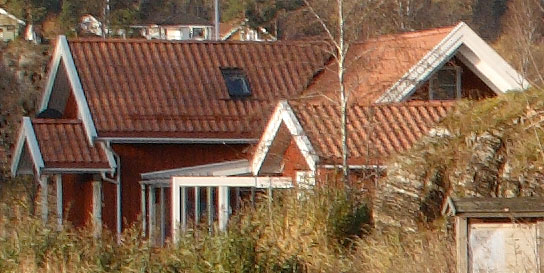
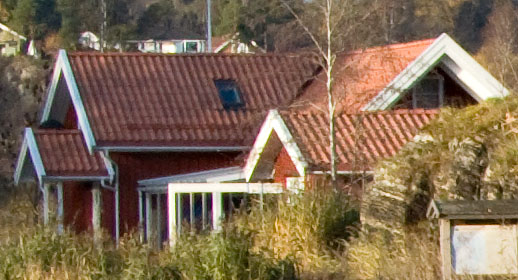
I find it curious that MR didn't notice the loss of sharpness in the outer zone of the Canon lens. Like Amin I noticed it immediately in the images posted in Photography Blog, and I have confirmed it in my own testing. In fairness it should be mentioned that the softness is significantly less at the longer focal lenghts. The Nikon lens is more conservatively specified, both in regard to zoom range (4x vs. 5x) and in speed and it shows. It draws nicely and evenly over the full imaging area.
Finally, let's not make too much of this, first of all we are comparing only two cameras, sample variation might throw this off completely. Secondly, even as it stands, both are state of the art small sensor cameras capable of excellent output.
Which one did I keep? By a small margin the P6000 (main reason: on the whole a better lens and smaller/lighter camera), but with better optical performance than my copy showed, it might just as well have been the G10.
Read More......
Posted by Amin
Labels:
Canon G10,
Nikon P6000
Michael Reichmann has published his comparison of the Nikon P6000 and Canon G10 along with some references to the Panasonic LX3/D-LUX 4. No spoilers here, but I'm interested to hear others' thoughts on this one, as I'm considering another shootout.
Link: The Luminous Landscape - Pocket Battleships
[Thanks Todd O]
Addendum (spoiler alert, do not read below until you have read the LL article):
Having read the article a couple times now, I'm not sure the crops shown are doing justice to the P6000 relative to the G10. Consider the following full-res JPEGs from PhotographyBLOG:
Canon G10
Nikon P6000
Note how the G10 is clearly outresolving the P6000 in the center of the frame; yet when you go out to the periphery, there is significant degradation of G10 image quality while the Nikon holds out right to the corners. Not one of the crops used in the L.L. comparison were taken from the peripheral region of the selected frame.
I don't agree that the P6000 is "uncompetitive" against both the G10 and the LX3. Sure the G10 is more fully featured, resolves more detail (at least in the center), and is almost a stop faster on the tele end. However, if the G10 is too large and heavy for you and the LX3 and GX200 don't go long enough to suit you, the P6000 is the obvious choice. It's good that we once again have a number of different choices amongst compact cameras that offer RAW. Not long ago, Panasonic and Ricoh were the only ones.
Read More......
Posted by Amin
Labels:
Canon G10,
Nikon P6000
Amazon has the Canon G10 for the lowest price yet at $464 with free shipping (link below). This is the lowest price I've seen yet for the G10.
Read More......
Posted by Amin
Labels:
Canon G10,
deals
In The Field
The next afternoon I hiked into the forest with my tripod, Hasselblad H2 and P45+ with the Hasselblad 55-110mm lens attached, and photographed a lovely deep forest fall scene. As I stood there wondering where to go next I put my hands in my vest pocket (it was a chilly fall morning), and there was the Canon G10.
Humm! I wonder how the it would compare with the H2/P45+ combo in a critically controlled side-by-side comparison. Nahh! Silly idea.
But – nothing ventured, etc, and so without a tripod mount for the G10 I simply held it firmly braced on top of the Hassy and did an exposure, framing the shot as closely as I could to what I'd done on the Hasselblad.
Read on at
The Luminous Landscape - You've Got to be Kidding!If that article makes you want a G10, good timing. Amazon has them in stock and just dropped the price to $482 shipped.
Featured Comment by
Walter K:
Michael Reichmann generally provides valuable information on his site, particularly when it comes to real field testing of DSLRs and Medium Format equipment, a service that most other review sites don't provide. His occasional forays into the realm of better quality compact digital cameras can be useful too. But not this time.
Michael Reichmann's recent experiment with Canon's G10 got my attention: “Could a $500 digicam equal a $40,000 medium format digital system in image quality, at least in prints up to 13X19" (Super A3)?" The answer, he seems to be saying, is yes, proclaiming that the "G10 has crossed a threshold". But after evaluating the full res files from the G10 and Phase One P45+ Back it's difficult to know exactly what threshold the G10 has crossed. The subject matter and conditions in which the test was conducted could not be more ill suited to comparing these two cameras.
When I first looked at the medium format image file at 100% I was taken aback at how much of the scene was out of focus due to shallow depth of field. The 1 second exposure further contributed to an overall softness of the scene as leaves are clearly being blown around by the wind. By contrast, as Reichmann admits, the G10 file has an overall crispness due to the shorter focal length lens and shorter shutter speed of 1/8 of a second (and what looks to me like over–sharpening). The medium format is thus at a distinct disadvantage, especially if one is expected to evaluate resolution and acutance in a super A3 print. Yet, in a ploy to dramatize the G10 underdog status in the story Reichmann states: "Overall if there was any technical bias in the test it was in favor of the medium format system".
Furthermore, there are additional problems related to the character of surface textures in the test scene. Noise is prominent in the G10 file, but the texture of tree bark and ground cover (the few areas of the scene that are reliably sharp) would most certainly act to camouflage adverse effects of noise artifacts in prints, further equalizing the apparent quality of the two cameras.
It would have been far more informative to readers to approach the experiment by showing both cameras performing optimally in the field, even if limiting the test to super A3 size print. Only then do you get to draw a conclusion (and a limited one at that) about the image quality between $500 camera and $40,000 system.
You can’t excuse a poorly conducted test by calling it “informal”. It’s still a poorly conducted test and few conclusions of any value can be drawn. The whole enterprise, accompanied as it is with so many caveats, yet so positive in its “threshold” crossing proclamations, only serves to undermine the credibility of the author and call in to questions his analytical skills.
Walter K
Read More......
Posted by Amin
Labels:
Canon G10
PhotographyBLOG has posted sample photos from the Nikon P6000 and Canon G10 in preparation for their upcoming reviews. There are 40 full-resolution in-camera JPEGs, 9 RAW files, and one sample video for each camera.
The subject matter is the same for many of the photos in each set, so this is a good chance to compare the relative performance of these cameras. A few of the matched samples favored the Canon, but overall I came away impressed with the corner to corner performance of the Nikon. I still think Nikon made a mistake putting such a slow (f/5.9 at the tele end) lens in their flagship compact, but the PhotographyBLOG P6000 samples are promising.
Links:
Nikon Coolpix P6000 Photos
Canon PowerShot G10 Photos
Read More......
Posted by Amin
Labels:
Canon G10,
Nikon P6000
Imaging Resource has posted a full set of Canon G10 test images, and they have added the G10 to their excellent Comparometer.
Links:
Imaging Resource - Canon PowerShot G10 Test Images
Imaging Resource - Comparometer
Read More......
Posted by Amin
Labels:
Canon G10,
Powerhot G10,
test images
DC Watch (Japan) has published on the Canon G10 their standard initial battery of tests. These include a look at sharpness at different focal lengths and apertures, bokeh, distortion, high ISO performance, and more. It is interesting to compare the G10 tests to the initial DC Watch tests for the Panasonic LX3.
For example, take a look at the ISO 80, f/4 output from these two cameras compared at their wide end. Keep in mind the differences in display size, field of view, degree of sharpening, and lighting:
Now take a look at the ISO 400 output from these two cameras:
The G10 is the best selling "advanced compact", at least in the United States, but the LX3 is quite an interesting challenger. On the basis of features, the two cameras obviously offer distinct functionality, particularly in terms of zoom coverage but also pixel number/size, lens speed, approach to viewfinder, etc. However, as different as they are, many photographers are still giving serious consideration to both of them. Bruce Buck of 60Hz Productions recently tested both and decided to keep the LX3 (
link). Scott Bourne of
TWIP also recently picked up an LX3 and decided to send back the G10. I've heard from several people who tested both and decided to keep the G10 or even both cameras! The DC Watch samples provide a useful, objective comparison of the two, particularly for JPEG shooters.
Links:
Read More......
Posted by Amin
Labels:
Canon G10,
Canon G10 tests,
DC Watch,
Panasonic LX3

Bruce Buck of 60Hz Productions has published an informative comparison of the Panasonic LX3 and Canon G10. There are quite a few image samples comparing the performance of the two cameras under similar conditions, and Bruce offers an excellent analysis at the outset.
Link:
60Hz Productions - Canon G10 vs Panasonic LX3
Read More......
Posted by Amin
Labels:
Canon G10,
Panasonic LX3
A poster in the DPReview Panasonic forum has shared some nice images comparing the dimensions of the Panasonic LX3 and Canon G10.
Link: DPReview Panasonic Talk Forum - LX3 vs G10 Size Comparison
Read More......
Posted by Amin
Labels:
Canon G10,
Panasonic LX3
The Canon G10 is now in stock and shipping for $499 Calumet via Amazon. I expect that current stock will sell out within the day today.
Update: As expected, the stock at Calumet didn't last long. However, the same Amazon link below will now take you to Amazon where the G10 still lists as in stock, this time at J&R. Let's see how long their stock lasts.
The G10 is also
available at B&H, another reseller I can recommend strongly.
Read More......
Posted by Amin
Labels:
Canon G10
Canon has announced the Powershot G10.
Key specifications are unchanged from the prior Pop Photo leak.
Features:
• 14.7 megapixel 1/1.7" CCD sensor
• 5x (28-140mm equivalent) f/2.8-4.5 optical zoom lens
• Optical image stabilization
• RAW format (supported in DPP and presumably most third-party software)
• DIGIC 4
• 3.0” LCD (461k dots resolution)
• Optical viewfinder
• Dedicated exposure compensation dial (new)
• Dedicated ISO dial (below/around mode dial)
• Manual exposure control and custom settings
• Accessories include tele-converter, Speedlite flashes and waterproof case
• 30fps VGA movies
Looks like there will be some nice half cases available in limited production:

[Thanks Marco]
Read More......
Posted by Amin
Labels:
Canon G10,
Canon Powershot G10
The Canon Powershot G10 announcement was published, apparently prematurely, on the PopPhoto.com website. The information has now been pulled. Even the Google cache is gone. All that remains is this:

The partial specifications were noted and posted in the DPReview and Fred Miranda forums.
Here's the scoop:
• 14.7MP
• 5x 28-140mm equivalent zoom lens
• RAW files editable in Canon's Digital Photo Pro
• Full-resolution ISO 1600, reduced resolution ISO 3200
• Dedicated dial for exposure compensation with ISO dial now wrapping around mode dial
• Available in October (SRP: $499)
I'd expect the official announcement to follow soon.
[Thanks Mayank
Read More......
Posted by Amin
Labels:
Canon G10,
Powershot G10

B&H Photo Video is listing the Canon Powershot G9 as "Discontinued". Getting more and more likely that the Canon G10 is coming soon.
[Thanks Michael]
Read More......
Posted by Amin
Labels:
Canon G10,
Canon Powershot G10
Mayank Bhatnagar started a thread in our discussion area regarding Canon's plans to use new CMOS sensors in compact cameras. As some may recall, this news was announced last summer. Rumors are circulating that we will see the first Canon compacts with larger sensors in time for Photokina in September of this year. While we've yet to see any good evidence for these rumors, Gordon Buck has posted evidence at Light Description that we will at least see a new G-series Powershot this year. Could the G10 feature a CMOS sensor, somewhat larger than the sensors found in the G-series to date? Or, as some rumors have suggested, could we see two advanced compacts from Canon at Photokina - one a G9 replacement, the other incorporating a larger (?CMOS) sensor?
It is likely that Panasonic, Canon, and Ricoh will introduce replacements for the LX2, G9, and GX100, respectively, in time for Photokina. We have reason to believe that both Canon and Panasonic are working to implement larger sensor designs in compacts, though we don't know when these compacts will be available, nor do we know whether they will supplement or replace existing lines. If anyone has more information, let us know!
Update: The Popular Photography briefly posted a G10 announcement containing some of the specifications (link).
Read More......
Posted by Amin
Labels:
Canon G10,
CMOS,
GX200,
Panasonic LX3,
Photokina,
Ricoh GX120