Update: Great news, Olympus will be providing an E-P1 kit for the shootout! Not surprisingly, E-P1 kits are on short supply right now, so it will be a while before we get one. Nevertheless, this will be the most thorough shootout yet, assuredly worth the wait! Many thanks again for the community support, via posts and tweets, without which this likely wouldn't have happened.
----------------------------------------------------
Thanks to everyone who commented on the previous post. With your help, we got the attention of Sigma, and they have agreed to provide a DP2 (hopefully with VF-21 viewfinder and HA-21 converter) for the shootout. Here they are announcing it on Twitter:
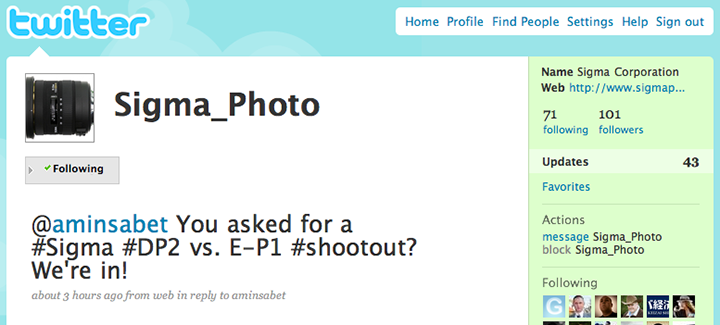
Very cool of Sigma to step to a direct shootout like that! So far, there is no definite commitment from Olympus. Two Olympus representatives on Twitter responded to my request by asking me to direct message them with my contact information. I did so yesterday and am waiting for them to get back to me.
I'm sure that their review units are in short supply so soon after the launch. Hopefully Sigma's willingness will inspire the Olympus folks to provide a test E-P1 and 17mm kit for the shootout. I don't think there is any more well defined market for these cameras than the one we represent.
If anyone would like to help lobby Olympus on Twitter, direct your tweets to @cjleonejr (Olympus PR) and @getolympus while mentioning #seriouscompacts so that I can keep track. Thanks again everyone!
Amin
Sigma Answers the Call! Waiting for Olympus...
Tuesday, June 23, 2009
Posted by Amin
Comments
 Labels:
DP2,
E-P1,
Olympus,
shootout,
Sigma
Labels:
DP2,
E-P1,
Olympus,
shootout,
Sigma
Sigma DP1 Close-up Lens AML-1 Review by Carl Rytterfalk
Thursday, June 19, 2008
Carl Rytterfalk has posted a great review of Sigma's close-up lens attachment for the DP1. Check it out here.
Read More......
Posted by Amin
Comments
Labels:
AML-1,
Carl Rytterfalk,
close-up lens,
DP1,
Sigma
Rytterfalk.com - One Day at a Time with the Sigma DP1
Monday, March 3, 2008
Carl Rytterfalk has posted early impressions of and samples (both stills and video) from the Sigma DP1 on each of the two days he has had the camera thus far. It is great to see even more of what this camera can do in the hands of a talented photographer. If you are interested in the DP1, be sure to bookmark www.rytterfalk.com.
Read More......
Posted by Amin
Comments
Labels:
Carl Rytterfalk,
DP1,
Sigma
Upsizing Images
Wednesday, February 27, 2008
After reviewing the official Sigma DP1 examples, my thoughts turned to the best method for upsizing them. While it is clear that these images contain a ton of detail, the choice of upscaling approach is important for getting the best possible extra large prints out of relatively small (4.65MP) files. As luck would have it, Ctein of The Online Photographer today posted Part 1 of a three-part comparison between Genuine Fractals, Blow Up, and Photoshop Bicubic. I'm looking forward to Parts 2 & 3, which are said to be coming over the next week.
In the meanwhile, I've been having fun experimenting with resizing approaches. In particular, I've been comparing Genuine Fractals and Photoshop Bicubic Smoother for their ability to upsize the DP1 samples to 14MP. The major problem I've encountered with upsizing the SD14 and DP1 files is that of aliasing artifacts (jaggies). Genuine Fractals seems to do an excellent job of preserving detail while minimizing these artifacts. I'm finding that the default setting on Genuine Fractals used to upsize followed by modest Smart Sharpening in PS (Amount 100, Radius 0.3) gives good results. In the comparison crops that follow, I compared this approach to Photoshop Bicubic Smoother, which required more aggressive subsequent sharpening (Smart Sharpen, Amount 200, Radius 1) for a similar degree of apparent detail. Disclaimers up front: 1) I don't yet have permission from Sigma to post upsized images, but I believe that using these tiny crops as examples is permissibile from a copyright standpoint. The original photographers for the images from which these crops were derived agreed with this; 2) JPEGs aren't the best source for upscaling. JPEG artifacts become more prominent; 3) Obviously my methods for upscaling may be suboptimal and therefore not representative of the DP1 X3 potential; 4) Rick Decker pointed out that the crop I chose from his image may not do justice to the sharpness possible with the DP1 given that the light wasn't that bright at the time of the capture.
Here are some examples (Click image for intended viewing size):

Another example (Click image for intended viewing size):

The differences are definitely subtle, and it would probably take quite a large print to show them. However, if you pick through looking for aliasing effects, they're present in the images resized using PS Bicubic to a greater extent than in those resized with GF5. The jaggies on the slope near the observatory are the most prominent example, but there are others if you look closely at 100%.
In a response to Ctein's article, Hugh Crawford posted the following insights regarding Genuine Fractals: "The behavior of the Genuine Fractals makes sense if you keep in mind that it was originally designed as a file compression program that converted the raster information to vector information and compressed it using wavelets. It tends to want to define things as areas with edges. On the one hand it does a good job of getting rid of aliasing effects on edges and sharpening them without the usual sharpening artifacts, but at the expense of wanting to make things look like areas with edges if the blur is near the sampling frequency." These comments agree well with my preliminary results shown above; and in examples not shown, I've seen a bit of the downside to which he referred.
I have written to Sigma for permission to feature upsampled images on this site. Depending on their reply, I will be able to more fully demonstrate the potential of this approach.
If you use the link below to join me in pre-ordering the DP1, Amazon will give me a small credit towards the purchase of my DP1. Thanks!
Posted by Amin
Comments
Labels:
Bicubic,
Blow Up,
DP1,
Genuine Fractals,
Large prints,
Photoshop,
Resizing,
SD14,
Sigma,
TOP,
Upresing,
Upscaling,
Upsizing
Your Input Needed for Sigma DP1 Shootout
Monday, February 18, 2008
Having pre-ordered the DP1, I'm working towards doing a shootout along the lines of the GX100 vs G7 vs D-LUX 2 Shootout. The issue is that there really isn't another camera like the DP1. The GRD II is probably the closest match from the standpoint of a photography tool, but others will likely do that comparison. Professional photographer and reviewer Sean Reid will no doubt do a thorough job of comparing the two when he does his DP1 review. Pavel Kudrys of Ricoh Forum has posted a number of excellent GRD II tests and has stated his intent to try to obtain a DP1 for comparison. Nevertheless, I'd be willing to add my comparisons to the mix. Alternatively, I could do a comparison of the Canon 5D and EF 28mm f/2.8 lens to the DP1, but that is unsatisfying for three reasons. First, the 5D is massive compared with the DP1, so they obviously serve different functions. Second, the 5D is a good deal more expensive; and third, the SD14 (which has the same sensor as the DP1) has already been compared with the 5D. The Canon G9 is a reasonable camera for comparison since it offers excellent image quality, RAW, and is only moderately larger than the DP1. It seems to be the compact carry of choice for a number of folks who are serious about photography. The main downside is that the G9 lens doesn't go wider than 35mm (equivalent). The upcoming Canon Rebel XSi/450D is an attractive candidate for the shootout since it is priced close to the DP1 and has a kit lens that goes to 28mm (equivalent). I'd be interested in seeing the DP1 compete against a 12MP, recently-announced entry-level DSLR. I'd choose the Canon over the Nikon equivalent simply because I already have a couple Canon lenses I could use with it. The downside, again, is that an XSi isn't compact. It also won't be available for testing until mid-April at the earliest. The Leica D-LUX 3 and its equivalent, the Panasonic LX2, are also under consideration. These are excellent cameras which offer wide angle, RAW, and, like the G9 are frequently the compact choice for serious photographers. The GX100 also deserves consideration but is off the list since the best comparison from Ricoh is almost certainly the GRD II. The Olympus E-410 with 14-42mm kit lens, as the most compact DSLR available, is another comparison some may find of great interest. The Olympus Stylus Epic is an old 35mm film compact with a 35mm f/2.8 fixed focal length lens. It would make for an interesting comparison, but somehow I doubt that many folks will have trouble deciding between this one and the DP1.
Perhaps you have a better suggestion, or maybe you think that a shootout would be pointless since the DP1 represents a new class of camera. Kindly let me know by responding to the poll featured to the right as well as by leaving your comments below. The poll restricts each individual to a single selection. The reason for this is that I have neither the time to test nor the money to buy all those cameras! I'm simply considering buying and/or borrowing one or two (max) for the purposes of a shootout and would like to get a sense of where the general interest lies. Thanks!
Posted by Amin
13
comments
Labels:
DP1,
review,
shootout,
Sigma
Sigma DP1 - 14MP or 4.6MP?
Sunday, February 17, 2008
The digital camera industry is heavily invested in the concept of megapixels, where one megapixel = one million pixels. One can define the number of megapixels based on the number of pixels in the camera sensor, or one can define the number based on the number of pixels in the resulting image. With nearly all cameras, there is no substantial difference between the two. For example, Canon's flagship compact digital camera, the Powershot G9, has a sensor made up of 12 million pixels in a single layer and outputs a final image that is 4000 pixels by 3000 pixels (12MP). The Foveon X3 sensor in the Sigma DP1 and SD14 is an exception. This sensor uses three layers of pixels with 4.6 million pixels in each layer. While that means that there are roughly 14 million pixels altogether in the sensor, the output of this sensor is an image measuring 2640 pixels by 1760 pixels (4.6MP). Sigma and Foveon detractors have pointed out the obvious discrepancy here. Clearly a 4.6MP output image cannot contain 14MP of detail. For essentially marketing reasons, Sigma is referring to the DP1 as a 14MP camera. After all, who would pay $1000 ($800 street) for a 4.6MP pocket camera?
As it turns out, Sigma is forcing us to re-evaluate megapixel ratings just as AMD forced us to re-evaluate gigahertz ratings in the computer processor industry. Not all megapixels are created equal from a detail standpoint, and that's without even considering other aspects of image quality including color fidelity, noise, and dynamic range. Anyone who's ever put a mediocre lens on a good DSLR can tell you that to do so is to literally throw away megapixels. In fact, it takes a very good lens to fully utilize the resolving ability of a sensor across the entire frame. Assuming one has such a good lens on hand, the next issue is whether the sensor itself can deliver in terms of "per pixel sharpness." For technical reasons that are well explained elsewhere, the sensors used in most cameras simply don't deliver as much detail as their megapixel ratings imply. Without delving into the reasons for this, it is easy to recognize the issue. View any image from a high megapixel camera on screen at 100%, and one can see that the level of detail simply isn't as high as it is in a resized image. At their "per pixel level," these images are just a little bit blurry. Typically speaking, one has to resize the image to 75% or less and then sharpen before the apparent detail is truly crisp. On average, this resizing step corresponds to an approximately 50% loss in megapixels. Depending on the particular camera and lens combination, the resizing may have to be even more significant. For example, a DSLR with a strong AA filter and a mediocre lens may output only a fourth of the advertised MP count in terms of true detail.
After examining hundreds of Sigma SD14 images and all available DP1 samples available online, it is clear to me that the me that this Foveon sensor provides better "per pixel sharpness" than any camera I have ever owned. The quality of the detail looks as good at 100% on screen as it does resized, and that is refreshing. Rather than advertising the DP1 as a 4.6MP camera with superior per pixel sharpness, Sigma has decided to classify it based on the number of pixels in the sensor. While the latter is indeed somewhat misleading, the former would have been disastrous from a marketing standpoint. As far as I am concerned, Sigma has been as forthright as have been other camera manufacturers in declaring megapixel counts. To quote Wikipedia's entry on the Pentium 4, "a review showed that in games, it took a 5.2 GHz Prescott core to soundly beat the performance of a 64-bit Athlon FX-55 that clocked at 2.6 GHz." Thanks to AMD, most of us now know that the gigahertz specification of a computer processor gives only limited information about overall performance. Thanks to Foveon and Sigma, it is more clear than ever that the megapixel rating is a highly limited assessment of the level of detail a camera can output.
Given the available samples from the SD14, I'm satisfied that the DP1 sensor (same as the SD14) can deliver higher overall image quality than that of any other pocket camera available to date. Based on the DPReview DP1 samples, I believe that the lens will be up to the task. Therefore, despite the fact that 28mm is not the single best focal length for my overall intended use - and with the understanding that the f/4 limitation is what it is - I pre-ordered the DP1 on Amazon earlier today. Amazon initially had the DP1 available for pre-order at a price of $750. It's currently at $800. Amazon's policy is to give one the lowest price at which it is listed between the time of pre-order placement and one month after shipping. No charges are made until the camera ships. After placing my order, I was given an estimated ship date of March 31 despite availability being listed as March 25. I'd be curious to know whether anyone else who pre-ordered earlier from Amazon was given an earlier ship date, as this would suggest that they are getting a significant number of orders.
If you decide to join me in pre-ordering the DP1 and would like to tip me in the process, you can do so by using the link below to get to Amazon.
Posted by Amin
5
comments
Labels:
DP1,
megapixels,
SD14,
Sigma
Whisperingcat Photography: "The Great 14MP Shootout"
Friday, February 15, 2008
Out of interest in the upcoming DP1, I've recently been reading everything I can find about the Sigma SD14, with which the DP1 shares a common sensor. That led me to Carl Rytterfalk's excellent site. Going through Carl's archives, I found a link to "The Great 14MP Shootout - Sigma SD14 vs Kodak 14nx" by Whisperingcat Photography. David Millier and Erik Muehlberger did an outstanding job of comparing the output of the Sigma SD14 and the Kodak 14nx. Their article is of general interest to anyone who pixel peeps 100% crops to gain information about sensors and of particular interest to those looking to learn more about the Foveon sensor in the DP1 and SD14. That comparison, again, is here.
Read More......
Posted by Amin
Comments
Labels:
14nx,
DP1,
Kodak,
SD14,
Sigma,
SLRn
Sigma DP1 Available This Spring
Wednesday, January 30, 2008

Sigma has announced that the long-awaited DP1 will be available this spring. DPReview has the press release and full specifications here. Unfortunately, I don't think this model will succeed. It's distinguishing feature is that it packs a large (APS-C) sensor into a compact form. However, one of the advantages most of us associates with larger sensors is cleaner performance at high ISO values. The fact that the DP1 has a maximum ISO setting of ISO 800, maximum shutter speed of 1/1000s, and a relatively slow f/4 lens assures that low-light handheld photography will not be a strength of this camera. That and the general public bias against prime lenses, particularly wide prime lenses, make it unlikely that the DP1 will sell particularly well. I hope that I am wrong and that the DP1 finds its niche. Who knows, it could be the next cult camera. Success or not, the DP1 will likely be an important camera. If it flops, it may be a long time before we see another attempt to bring a large sensor compact camera to market. If it sells, it will pave the way for other interesting new models to come.
The DP1 is now available for pre-order from Amazon with a release date of March 25.
Posted by Amin
Comments
Labels:
DP1,
Sigma
Third-Party Lens Manufacturer Poll
Monday, December 3, 2007
Posted by Amin
Comments
Labels:
poll,
Sigma,
Tamron,
third-party lens,
Tokina
Sigma Update on the DP1
Friday, November 30, 2007

Sigma has updated us on the status of the DP1, a product they announced over a year ago. As most of you know, the alleged DP1 is groundbreaking in that it is a compact digital camera with a large sensor. While I'm pleased to learn that Sigma hasn't scrapped the idea entirely, I refuse to get excited about a product that has been delayed this long. If the fixed 28mm f/4 lens were a 35mm f/2.8 lens instead, I'd probably manage a bit more enthusiasm. That said, even with total light-gathering ability similar to a small sensor camera with a fast lens, the large Foveon sensor should provide really nice dynamic range and color, likely best-in-class amongst compact cameras.
Someone wake me up when this thing is on the shelves, okay?
Posted by Amin
2
comments
Labels:
c'mon already,
DP1,
f/4,
large sensor,
not real,
old news,
Sigma,
vaporware