
As some of you know, Panasonic has sent out invitations for a July 17 event in New York City at which they will be announcing new cameras. Some are speculating that we will see a lower priced DSLR offering. I'm hoping that we see some sort of upgrade on the FZ50. At any rate, I'm excited to see what they bring out. Panasonic has certainly been more innovative lately than Canon or Nikon in the compact digital camera space.
Read More......
New Panasonic Cameras Coming July 17
Friday, July 13, 2007
Posted by Amin
Comments
 Labels:
July 17,
Panasonic
Labels:
July 17,
Panasonic
Bring on 1" Sensors (Bridge Cameras, Part 2)
Wednesday, July 11, 2007
Recently, Thom Hogan updated an article describing the sort of compact camera he wants. Many have also read of Mike Johnston's desire for a DMD. Thom believes that the technology is currently available to design a compact camera with a relatively fast (f/2.8-4) zoom and an APS-C sensor. I remain skeptical about this; however, thinking about these issues in camera design has me wondering again about my old friend, the bridge camera.
Before continuing, it would be helpful to review relative sensor sizes among currently available cameras. The following image demonstrates some common relative sensor sizes. Of course the actual sensors are smaller than depicted.
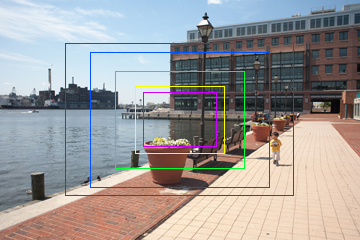
The entire image corresponds to the relative size of a "full frame" digital sensor such as the one in the Canon 5D. The red, blue, green, yellow, and purple lines correspond to the relative sizes of APS-C, 4/3", 1", 2/3", and 1/1.8" sensors respectively. The background image is there to illustrate the "crop factor," which is beyond the scope of my brief post here. The largest sensors in current, very compact cameras are around 1/1.7". Not too long ago, we had 2/3" sensors. Now, the next step up in sensor size from 1/1.7" (which would be between purple and yellow in the image above) is a huge leap to 4/3" (depicted above in blue). Comparing the smallest 4/3 system, the Olympus E-410 with kit lens, with DSLR systems based around the next step up in sensor size (APS-C) demonstrates the fact that smaller systems can be designed around smaller sensors. The, as of yet vaporware, Sigma DP1 promises a compact camera featuring an APS-C sensor. Likely this is possible in part since no mirror mechanism is incorporated, and in part because the DP1 features a prime lens of modest speed (f/4).
Why is there a leap from 1/1.7" to 4/3"? Surely a non-SLR digital camera with a 1" current-generation-technology sensor could be designed to be smaller than any DSLR + equivalent focal length range lens kit. Such a non-SLR camera would certainly provide better image quality and greater potential for shallow DOF than any current, smaller sensor compact digital cameras. The way I see it, these 1" sensor cameras could be made no larger than current "superzoom" cameras such as the Canon S5 IS or Olympus SP-550 by incorporating the tradeoff of a larger sensor and a more modest (2-3x) zoom range. Take, for example, my old Leica Digilux 2 (D2). The D2 could be made more compact today by 1) applying current generation design methods, and 2) making the lens non-fixed in length. The second of those two changes is not something I'd want, but it's worth mentioning that it could be done. In addition, one could presumably increase the D2 sensor size from 2/3" to 1" without increasing the overall size (largely determined by the lens size), if one were willing to accept a slower zoom, such as f/2.8-3.5 rather than f/2-2.4.
It makes no sense to me that we have only cameras with sensor sizes of 1/2.5", 1/1.8", 1/1.7", 4/3", 1.8" (APS-C), and 35mm. There is a large gap between 1/1.7" and 4/3" that is waiting to be plugged with 1" sensors. I am confident that bridge cameras derived from such sensors could be profitable in 2007 and beyond. Read More......
Posted by Amin
2
comments
Labels:
Bridge cameras,
digital camera,
sensor size
PopPhoto Reviews the Ricoh GX100
Thursday, July 5, 2007
Continuing on with GX100 coverage, I was glad to see another professional review today, this one from Popular Photography. Their summary statement was as follows:
"The GX100 is a highly competent camera that's easy and fun for both the casual shooter and the serious enthusiast to use. We like it. But we'd like it more if it cost a little less and had less noise at high ISOs."Compared to the G7, they had the following to say:
"The Ricoh scores higher on image quality -- in both noise and resolution -- and offers RAW capture, absent on the Canon."Overall, I found it to be a clearly positive review and worth a read. Read More......
Posted by Amin
Comments
Labels:
PopPhoto,
review,
Ricoh GX100
More GX100 Appreciation
Tuesday, July 3, 2007
I'm beginning to settle in with the Ricoh GX100 in a way that I never realized with the Canon G7. The following is just a simple photo which highlights a few aspects that make the Ricoh special amongst current compact digital camera offerings.
The first and perhaps the most significant feature is that the zoom range starts at 24mm (35mm film equivalent), which is the focal length I used here. Second, it gives one access to the RAW file, which I needed in order to bring push the exposure enough to selectively bring out some shadow detail to match the scene as I recalled it. The image stabilization performs well, allowing me to get a blur-free ISO 80 image in this relatively low light. Finally, it is very compact, facilitating the important matter of having the camera present.
As an aside, my family recently moved from Baltimore City out to the Maryland suburbs, very close to this great park which is home (or hunting grounds) for a variety of wildlife including herons, beavers, swans, geese, and eagles. For the first time, I am tempted to get some equipment with true reach. Still not sure whether I should stay compact (eg. Panasonic FZ50) or think about carting around a long lens for the DSLR. If I weren't lugging around two small children with me, it would be a much easier decision!

Posted by Amin
5
comments
Labels:
Centennial Park,
G7,
GX100,
RAW,
wide angle
My Main Digital Camera is Four Years Old.
Sunday, July 1, 2007
My dad recently asked me why I generally carry a four-year-old camera, the Leica Digilux 2 (D2), when I have several more recent bodies to choose from. Clearly I am not alone. The Leica D2 and its Panasonic clone, the LC1, continue to find themselves in the hands of photographers who own much newer and more expensive equipment. Despite known sensor susceptibility to failure, these cameras also command a very high cost on the used market considering their age. They are 5 megapixel cameras, only go up to ISO 400, take about 5 seconds to buffer a RAW image, and don't autofocus very quickly. Why then do we carry them? Some love the appearance, feel, controls, and optically-great DC Vario Summicron lens. I carry it for the following reasons:
- 28-90mm (equivalent) is a nearly perfect focal length range for my general needs.
- With its relatively large (2/3") sensor, the D2/LC1 can achieve some nice portrait background blur at 90mm and f/2.4.
- The f/2-2.4 zoom is nice and fast.
- The relatively large pixel pitch makes for good dynamic range and tone separation.
- The noise at higher ISO values has a more pleasing quality than that of any other small-sensor digital camera I have tried.
- There's something about a mechanically-linked zoom that just feels right.
No small-sensor digital camera currently made can replace this one in my kit. Until now, no cameras with larger sensors and an equivalent zoom range have been compact enough to replace it. None are as quiet, which is another thing I appreciate about the D2. I do have my eye on the new Olympus E-410 with kit lens, which looks to be a viable alternative in most respects. If you are interested in learning more about the Digilux 2, I recommend the following two reviews:
http://photo.net/equipment/leica/digilux2/
http://www.luminous-landscape.com/reviews/cameras/leica-digilux2-part1.shtml
Posted by Amin
2
comments
Labels:
bridge,
Digilux 2,
LC1,
Leica,
Panasonic
Subscribe to:
Posts (Atom)


