
It has been widely held that the Four Thirds system offers better corner sharpness than does traditional 35mm photography, so as a user of both systems I thought I'd do a simple test.
Systems compared:
1) Canon 5D (35mm sensor) with EF 28mm f/2.8 prime. This is a cheap lens with sharper corners at 28mm than the more expensive Canon 28mm f/1.8 copy I previously owned. Obviously this lens does not represent the ultimate in corner sharpness available for the 5D (that would require some very expensive glass), but it competes well with the much more expensive L zooms at this focal length (confirmed by SLRGear testing). Look here for a comparison of 13 lenses at this focal length tested on a 5D. You can see that the 28/2.8 is no slouch.
2) Olympus E-410 with 14-42mm zoom (kit lens)
In terms of lens and body, I was somewhat unfair to the Four Thirds system here. The 14-42 is outperformed by the higher cost Olympus zooms (also confirmed by SLRGear testing), and the E-410 has less per-pixel sharpness than the Panasonic DMC-L10 or Olympus E-3.
The 5D was at ISO 800 with the 28mm lens stopped down to f/11
The E-410 was at ISO 200 with the kit lens at 14mm and f/5.6
This was done so that the two systems would produce images with the same depth of field, diagonal angle of view, perspective, and apparent exposure given the same shutter speed and print size.
Shutter speed with both systems was 1/250s. Unfortunately I left my tripod at my parents' home, so both systems were shot handheld. I picked the best of four shots in each case. In each case, all four shots came out the same. I can reliably handhold a 28mm lens at 1/250s.
For processing, I converted from proprietary RAW to DNG in Lightroom and then processed in C1 4 beta using default sharpening (same for both cameras) and zero noise reduction.
More points to consider: 1) To compare these images, they should be examined at the same print size. I did not upres the E-410 photo or downres the 5D photo because the method used to do either could potentially introduce bias. Of course you can do this on your own. I printed them for comparison. 2) C1 doesn't have a specific color profile for the E-410. Color differences here are not representative of these camera models IMO. 3) These two lenses do not represent all lenses available for their given systems (duh). Again, this is a cheap prime designed decades ago versus a cheap zoom designed recently.
Click here for the two images with full-res version and EXIFs available.
Here they are as resized by Flickr. You can see the smearing in the extreme corners of the Canon shot even at this size (Click image for the intended viewing size):
In contrast, corner softness is barely apparent on the Olympus image at this size (Click image for the intended viewing size):
Here's a representative corner crop (Click image for the intended viewing size):
This crop shows the greater overall resolution and accutance of the particular Canon system used in this comparison (Click image for the intended viewing size):
My observations: 1) Softness in the extreme corners was clearly present on the Canon image and much more subtle with the Olympus image. 2) The overall detail rendered by the Canon system was greater. 3) Noise levels were comparable.
Again, this is just one comparison. While I found the results interesting, more lenses and bodies from each format would have to be compared to reach significant conclusions.
Corner sharpness: Four Thirds vs 35mm
Sunday, December 23, 2007


Posted by Amin
Comments
 Labels:
14-42mm,
28mm,
35mm,
Canon 5D,
corner sharpness,
format size,
Four Thirds,
Olympus,
sensor size
Labels:
14-42mm,
28mm,
35mm,
Canon 5D,
corner sharpness,
format size,
Four Thirds,
Olympus,
sensor size
Panasonic DMC-L10 vs Olympus E-510 Per-Pixel Sharpness
One of the things I've noticed about images from my Olympus E-410 is that they display less "per-pixel" sharpness than those from my Canon 5D. I can attribute this in part to the fact that I use some nice primes with the 5D, whereas I use only the "Standard" class of Olympus glass on my E-410. The weak anti-aliasing filter on the 5D is another likely factor. However, I have wondered whether the Canon's larger pixels were a bit easier on the resolving ability of the lens, since I noticed a step up in sharpness going from the 30D to the 5D. By comparison, all Four Thirds sensors have quite a high pixel density, and I wasn't sure whether Four Thirds glass could deliver the resolution to match. The recent Panasonic DMC-L10 review at DPReview has nicely addressed this issue. Compared to the E-510, which shares the same sensor as my E-410, the L10 sensor appears to deliver superior per-pixel sharpness. See the comparison here. All crops in that comparison were processed identically from RAW, and the excellent Olympus ZD 50mm macro was used on both bodies. The L10 crops show the sort of resolution I have come to expect from the 5D, so I have concluded that the Olympus glass is up to the task. Hopefully the next generation super-compact body from Olympus will have a similar sensor to the one in the L10, In my case, it doesn't matter much given my choice of lenses. The 14-42mm kit lens, which I love, is well matched to the abilities of the E-410 sensor.
Read More......
Posted by Amin
Comments
Labels:
14-42mm,
5D,
Canon,
E-410,
e-510,
Olympus,
Panasonic,
per-pixel sharpness,
pixel peeping,
sensor size,
ZD 50
Small Format Deep DOF Advantage - Fact or Myth?
Wednesday, November 28, 2007
This content has been moved to the new SeriousCompacts.com.
Click here to go to the new location
Posted by Amin
Comments
Labels:
5D,
Canon,
DOF,
equivalence,
format size,
GX100,
joe mama,
noise,
read noise,
Ricoh,
sensor size,
shot noise
Bring on 1" Sensors (Bridge Cameras, Part 2)
Wednesday, July 11, 2007
Recently, Thom Hogan updated an article describing the sort of compact camera he wants. Many have also read of Mike Johnston's desire for a DMD. Thom believes that the technology is currently available to design a compact camera with a relatively fast (f/2.8-4) zoom and an APS-C sensor. I remain skeptical about this; however, thinking about these issues in camera design has me wondering again about my old friend, the bridge camera.
Before continuing, it would be helpful to review relative sensor sizes among currently available cameras. The following image demonstrates some common relative sensor sizes. Of course the actual sensors are smaller than depicted.
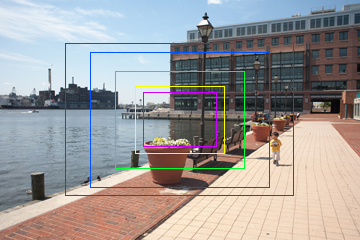
The entire image corresponds to the relative size of a "full frame" digital sensor such as the one in the Canon 5D. The red, blue, green, yellow, and purple lines correspond to the relative sizes of APS-C, 4/3", 1", 2/3", and 1/1.8" sensors respectively. The background image is there to illustrate the "crop factor," which is beyond the scope of my brief post here. The largest sensors in current, very compact cameras are around 1/1.7". Not too long ago, we had 2/3" sensors. Now, the next step up in sensor size from 1/1.7" (which would be between purple and yellow in the image above) is a huge leap to 4/3" (depicted above in blue). Comparing the smallest 4/3 system, the Olympus E-410 with kit lens, with DSLR systems based around the next step up in sensor size (APS-C) demonstrates the fact that smaller systems can be designed around smaller sensors. The, as of yet vaporware, Sigma DP1 promises a compact camera featuring an APS-C sensor. Likely this is possible in part since no mirror mechanism is incorporated, and in part because the DP1 features a prime lens of modest speed (f/4).
Why is there a leap from 1/1.7" to 4/3"? Surely a non-SLR digital camera with a 1" current-generation-technology sensor could be designed to be smaller than any DSLR + equivalent focal length range lens kit. Such a non-SLR camera would certainly provide better image quality and greater potential for shallow DOF than any current, smaller sensor compact digital cameras. The way I see it, these 1" sensor cameras could be made no larger than current "superzoom" cameras such as the Canon S5 IS or Olympus SP-550 by incorporating the tradeoff of a larger sensor and a more modest (2-3x) zoom range. Take, for example, my old Leica Digilux 2 (D2). The D2 could be made more compact today by 1) applying current generation design methods, and 2) making the lens non-fixed in length. The second of those two changes is not something I'd want, but it's worth mentioning that it could be done. In addition, one could presumably increase the D2 sensor size from 2/3" to 1" without increasing the overall size (largely determined by the lens size), if one were willing to accept a slower zoom, such as f/2.8-3.5 rather than f/2-2.4.
It makes no sense to me that we have only cameras with sensor sizes of 1/2.5", 1/1.8", 1/1.7", 4/3", 1.8" (APS-C), and 35mm. There is a large gap between 1/1.7" and 4/3" that is waiting to be plugged with 1" sensors. I am confident that bridge cameras derived from such sensors could be profitable in 2007 and beyond. Read More......
Posted by Amin
2
comments
Labels:
Bridge cameras,
digital camera,
sensor size


