
It has been widely held that the Four Thirds system offers better corner sharpness than does traditional 35mm photography, so as a user of both systems I thought I'd do a simple test.
Systems compared:
1) Canon 5D (35mm sensor) with EF 28mm f/2.8 prime. This is a cheap lens with sharper corners at 28mm than the more expensive Canon 28mm f/1.8 copy I previously owned. Obviously this lens does not represent the ultimate in corner sharpness available for the 5D (that would require some very expensive glass), but it competes well with the much more expensive L zooms at this focal length (confirmed by SLRGear testing). Look here for a comparison of 13 lenses at this focal length tested on a 5D. You can see that the 28/2.8 is no slouch.
2) Olympus E-410 with 14-42mm zoom (kit lens)
In terms of lens and body, I was somewhat unfair to the Four Thirds system here. The 14-42 is outperformed by the higher cost Olympus zooms (also confirmed by SLRGear testing), and the E-410 has less per-pixel sharpness than the Panasonic DMC-L10 or Olympus E-3.
The 5D was at ISO 800 with the 28mm lens stopped down to f/11
The E-410 was at ISO 200 with the kit lens at 14mm and f/5.6
This was done so that the two systems would produce images with the same depth of field, diagonal angle of view, perspective, and apparent exposure given the same shutter speed and print size.
Shutter speed with both systems was 1/250s. Unfortunately I left my tripod at my parents' home, so both systems were shot handheld. I picked the best of four shots in each case. In each case, all four shots came out the same. I can reliably handhold a 28mm lens at 1/250s.
For processing, I converted from proprietary RAW to DNG in Lightroom and then processed in C1 4 beta using default sharpening (same for both cameras) and zero noise reduction.
More points to consider: 1) To compare these images, they should be examined at the same print size. I did not upres the E-410 photo or downres the 5D photo because the method used to do either could potentially introduce bias. Of course you can do this on your own. I printed them for comparison. 2) C1 doesn't have a specific color profile for the E-410. Color differences here are not representative of these camera models IMO. 3) These two lenses do not represent all lenses available for their given systems (duh). Again, this is a cheap prime designed decades ago versus a cheap zoom designed recently.
Click here for the two images with full-res version and EXIFs available.
Here they are as resized by Flickr. You can see the smearing in the extreme corners of the Canon shot even at this size (Click image for the intended viewing size):
In contrast, corner softness is barely apparent on the Olympus image at this size (Click image for the intended viewing size):
Here's a representative corner crop (Click image for the intended viewing size):
This crop shows the greater overall resolution and accutance of the particular Canon system used in this comparison (Click image for the intended viewing size):
My observations: 1) Softness in the extreme corners was clearly present on the Canon image and much more subtle with the Olympus image. 2) The overall detail rendered by the Canon system was greater. 3) Noise levels were comparable.
Again, this is just one comparison. While I found the results interesting, more lenses and bodies from each format would have to be compared to reach significant conclusions.
Corner sharpness: Four Thirds vs 35mm
Sunday, December 23, 2007


Posted by Amin
Comments
 Labels:
14-42mm,
28mm,
35mm,
Canon 5D,
corner sharpness,
format size,
Four Thirds,
Olympus,
sensor size
Labels:
14-42mm,
28mm,
35mm,
Canon 5D,
corner sharpness,
format size,
Four Thirds,
Olympus,
sensor size
CV 28/35 Minifinder
Sunday, July 15, 2007
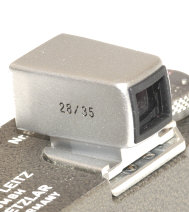
The Cosina Voigtlander 28/35 Mini-Finder was introduced at PMA in 2004, came in chrome or black, and contains brightlines for 28 and 35mm which are visible at all times. From what I can tell, this model has been discontinued, and only the larger viewfinders are being made. However, one can still purchase this viewfinder here from CameraQuest. I bought mine a few days ago and received it yesterday. For my purposes, this viewfinder makes an excellent companion for the Ricoh GX100. It's far more compact than the Ricoh EVF and avoids the lag associated with the image reaching an EVF. It is very bright for its size, and the image seen is sharp. Eye relief is just acceptable. Wearing eyeglasses, I can make out the entire 28mm brightlines just barely. Framing via the Voigt Mini-Finder is in 3x2 aspect ratio, so in practice the vertical FOV is greater than that included within the brightlines, whereas the horizontal FOV is accurate. It hasn't taken me long to adjust for this issue. The major limitation, of course, is that the VF has guides only for 28 and 35mm, not 24, 50, or 72mm (the other focal length equivalents supported by the GX100 step zoom). However, 90% of my photos are at 28 or 35mm, so this works well for me. For the other focal lengths, I will either compose with the LCD or simply estimate using the OVF. One final consideration is that this finder blocks the GX100 popup flash. I hardly ever use this flash, so it won't bother me. However, since the the viewfinder has to be physically removed to use the on-board flash, it is certainly something to consider.
I did consider buying the Ricoh GV-1 OVF, which is made for the GRD. However, as the GV-1 is offset to match the location of the GRD lens, it won't match the midline position of the GX100 hot shoe relative to the lens. Furthermore, the GV-1 is rather large and lacks a brightline for 35mm.
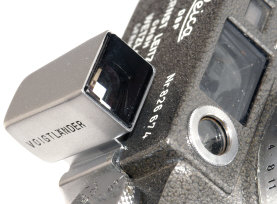
Here are a couple more views of the CV 28/35 Mini-Finder, again used with permission from Stephen Gandy from CameraQuest.
If I get a chance, I'll update this post later with some images of the CV 28/35 Mini-Finder mounted on the GX100.
Posted by Amin
Comments
Labels:
28/35,
28mm,
35mm,
EVF,
GX100,
Mini-Finder,
OVF,
Viewfinder,
Voigtlander
Prime Lenses
Saturday, May 19, 2007
"There's a special pleasure in shooting with primes. When you're restricted to one focal length, you can learn to see in it: visualize the picture even before putting the camera to your eye. I'm sure that with experience and talent this works for zooms too; I've just never gotten that far." -Petteri Sulonen
In still photography, a prime lens is a lens with a fixed focal length. A zoom lens, on the other hand, has a variable focal length. Zoom lenses, due to their greater versatility, have largely supplanted prime lenses. However, with the ever increasing affordability and thus popularity of DSLR photography, many of us who previously shot with fixed lens cameras now have the option of trying different types of interchangeable lenses. Amongst these, prime lenses offer a number of clear advantages.
1) They are lighter and more compact.
2) They often have simple designs, which are optically less compromising than zoom lenses. Modern zooms are very, very good. However, the greater the zoom range (ie, 4x), the more compromise is typically involved. For example, the wonderful Canon EF 24-105mm f/4L IS USM, which costs about $900, has a fair amount of barrel distortion at 24mm; whereas the EF 24mm f/2.8 prime lens, which costs about $200, has none.
3) More often than not, inexpensive primes offer better image quality than inexpensive zooms.
4) They are usually faster (greater maximum aperture) than zoom lenses of similar cost.
In addition to these quantifiable qualities, primes offer an additional advantage which is much less clear. As Petteri mentioned, there is a "special pleasure" in shooting them. With a prime, a given focal length takes on the charming character of familiarity. A prime can also encourage one to see in a certain way. For example, when I go out with the versatile 24-105mm zoom lens, which covers a focal range from ultra-wide to moderate telephoto, I have a tendency to stay further away from my subject and telephoto my way in. The effect is that I am less interactive, my perspective renders subjects more flat, and I end up including less environment in my candid photos of people. Each of these three factors has a negative influence on my shooting outcomes, and together their negative effects are additive if not synergistic. Now many zoom lens users would be quick to point out that not a single one of those effects is due to any inherent weakness of my zoom, and they would be correct. After all, if I mentally tape my zoom at 28mm, then it effectively becomes a 28mm f/4 prime, and not a bad one at that. However, my mind is weak, and I am guessing that I am not the only one. Furthermore, shooting with primes has definitely affected the way I use my zooms. These days, having learned from a couple of my prime lenses, I make better use of my feet, spend far less time on the telephoto end of my zooms, and take in more of the big picture. Even so, I suspect it will be many years before I progress to the point where prime lenses no longer push me to see better.
Amongst the more objective advantages of shooting with primes, the size and weight advantage is the most significant one from my standpoint. Today I visited the Baltimore Inner Harbor as well as Fells Point with my two boys, Oliver and Philip, aged four and two. For nearly half of my photos today, I was either carrying Philip in my left arm or holding his hand. There is simply no way I could have managed with a big heavy zoom like the 24-70L, and the smaller 24-105L would have been pushing it. Managing the 5D with a 28mm f/2.8 prime attached was a genuine pleasure. It would have been no problem to throw a 50mm prime in my jacket pocket had I wanted the security of being able to change focal lengths. However, I found that once I was in the 28mm mindset, I didn't even think of changing lenses.
Over in the DPR Canon Lens Forum, two common discussion threads are "Which one lens should I buy for my DSLR?" and "I'm leaving Canon for Nikon because Canon doesn't have an 18-200mm lens." The market dominance of zooms over primes has been firmly established, and I'd be the first to admit that prime lenses aren't for everyone. However, I would encourage any DSLR user to at least try taking pictures with a prime.
Right now, 28mm is my favorite focal length. If you are a zoom user, you might not have a favorite focal length. Maybe you think all the focal lengths are special, or perhaps none of them. However, if you give a couple inexpensive prime lenses a chance, I'll bet that before long you'll have a favorite focal length too.
Posted by Amin
8
comments
Labels:
28mm,
lenses,
prime,
zoom
Buying a new lens
Monday, May 14, 2007
I've been thinking a lot recently about buying a new lens for street shooting with the 5D. The 24-105mm f/4L is incredibly versatile but makes for a heavy combination with the 5D at 3.5 lbs combined (2lbs for the 5D and 1.5 lbs for the 24-105L). It's also a somewhat imposing lens to have pointed in one's direction. I enjoy using the 5D with the 50mm f1.4 but want something wider. I've now settled on one of the oldest and possibly the most forgotten lens in the EF lineup, the 28mm f/2.8. Surprisingly, there are some reports that this lens is a better performer on full frame than on crop bodies (excepting light falloff of course), which would go a ways towards explaining why it has been largely forgotten in this digital age.
Why the EF 28mm f/2.8?
- At 1.7" long and 0.41 lbs, this lens is tiny.
- At an average used price of around $120, it's cheap. No Canon autofocus lens with a metal mount is cheaper.
- 28mm is an awesome focal length.
- It has a distance scale, great for setting up to take quick shots from the hip.
- Markus Hartel uses one.
Click here for an interesting comparison of 13 lenses at 28mm, tested on a Canon 5D. I think the EF 28mm f/2.8 does pretty well.
That's all for now. More when I get the lens!

Posted by Amin
Comments
Labels:
28mm,
Canon,
lens,
prime


