
After about a year of trying, I have failed to get good looking black-and-white images from my digital workflow. With that in mind, I recently bought my first 35mm film camera in years, a Canonet GIII QL17 rangefinder. Unfortunately, that camera had a stuck shutter release and stripped light seals, so I bought another one. The second was also plagued by issues, this time related to the pressure plate scratching film. Yet, the few rolls of film I put through these cameras were enough to convince me that even C41 B&W film (Ilford XP2) developed and scanned at Costco had more of the look I have been pursuing than I can get out of my Canon 5D and Alien Skin Exposure. Here's a shot of my son Oliver off the first roll. He was so excited to meet Santa while my wife was shopping for a purse =).
The issues finding a good Canonet prompted me to look elsewhere. I considered buying a Bessa R3A with a Nokton 40/1.4, but that's just a little more than I'd like to spend on a film camera right now. Although I enjoyed the rangefinder experience with the Canonets, the most cost-effective way for me to go with film right now was the SLR route. I already own a few nice lenses for the Olympus OM system (purchased for use via adapter on the Canon 5D), so I went ahead and purchased the Olympus OM 2n film SLR camera.
My new camera should be here soon. Hopefully I will have better luck with this purchase!
Giving Film a Chance.
Saturday, December 29, 2007

Posted by Amin
Comments
 Labels:
35mm,
black and white,
Canonet,
digital camera,
film,
Olympus OM 2n
Labels:
35mm,
black and white,
Canonet,
digital camera,
film,
Olympus OM 2n
Corner sharpness: Four Thirds vs 35mm
Sunday, December 23, 2007
It has been widely held that the Four Thirds system offers better corner sharpness than does traditional 35mm photography, so as a user of both systems I thought I'd do a simple test.
Systems compared:
1) Canon 5D (35mm sensor) with EF 28mm f/2.8 prime. This is a cheap lens with sharper corners at 28mm than the more expensive Canon 28mm f/1.8 copy I previously owned. Obviously this lens does not represent the ultimate in corner sharpness available for the 5D (that would require some very expensive glass), but it competes well with the much more expensive L zooms at this focal length (confirmed by SLRGear testing). Look here for a comparison of 13 lenses at this focal length tested on a 5D. You can see that the 28/2.8 is no slouch.
2) Olympus E-410 with 14-42mm zoom (kit lens)
In terms of lens and body, I was somewhat unfair to the Four Thirds system here. The 14-42 is outperformed by the higher cost Olympus zooms (also confirmed by SLRGear testing), and the E-410 has less per-pixel sharpness than the Panasonic DMC-L10 or Olympus E-3.
The 5D was at ISO 800 with the 28mm lens stopped down to f/11
The E-410 was at ISO 200 with the kit lens at 14mm and f/5.6
This was done so that the two systems would produce images with the same depth of field, diagonal angle of view, perspective, and apparent exposure given the same shutter speed and print size.
Shutter speed with both systems was 1/250s. Unfortunately I left my tripod at my parents' home, so both systems were shot handheld. I picked the best of four shots in each case. In each case, all four shots came out the same. I can reliably handhold a 28mm lens at 1/250s.
For processing, I converted from proprietary RAW to DNG in Lightroom and then processed in C1 4 beta using default sharpening (same for both cameras) and zero noise reduction.
More points to consider: 1) To compare these images, they should be examined at the same print size. I did not upres the E-410 photo or downres the 5D photo because the method used to do either could potentially introduce bias. Of course you can do this on your own. I printed them for comparison. 2) C1 doesn't have a specific color profile for the E-410. Color differences here are not representative of these camera models IMO. 3) These two lenses do not represent all lenses available for their given systems (duh). Again, this is a cheap prime designed decades ago versus a cheap zoom designed recently.
Click here for the two images with full-res version and EXIFs available.
Here they are as resized by Flickr. You can see the smearing in the extreme corners of the Canon shot even at this size (Click image for the intended viewing size):
In contrast, corner softness is barely apparent on the Olympus image at this size (Click image for the intended viewing size):
Here's a representative corner crop (Click image for the intended viewing size):
This crop shows the greater overall resolution and accutance of the particular Canon system used in this comparison (Click image for the intended viewing size):
My observations: 1) Softness in the extreme corners was clearly present on the Canon image and much more subtle with the Olympus image. 2) The overall detail rendered by the Canon system was greater. 3) Noise levels were comparable.
Again, this is just one comparison. While I found the results interesting, more lenses and bodies from each format would have to be compared to reach significant conclusions.


Posted by Amin
Comments
Labels:
14-42mm,
28mm,
35mm,
Canon 5D,
corner sharpness,
format size,
Four Thirds,
Olympus,
sensor size
CV 28/35 Minifinder
Sunday, July 15, 2007
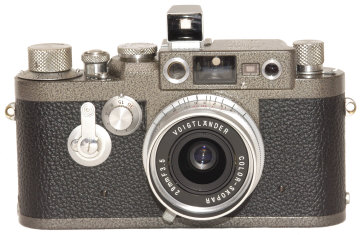
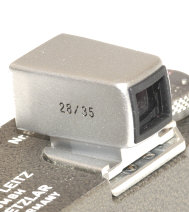
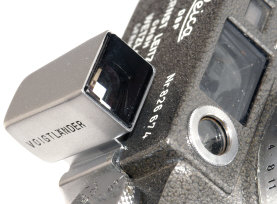
The Cosina Voigtlander 28/35 Mini-Finder was introduced at PMA in 2004, came in chrome or black, and contains brightlines for 28 and 35mm which are visible at all times. From what I can tell, this model has been discontinued, and only the larger viewfinders are being made. However, one can still purchase this viewfinder here from CameraQuest. I bought mine a few days ago and received it yesterday. For my purposes, this viewfinder makes an excellent companion for the Ricoh GX100. It's far more compact than the Ricoh EVF and avoids the lag associated with the image reaching an EVF. It is very bright for its size, and the image seen is sharp. Eye relief is just acceptable. Wearing eyeglasses, I can make out the entire 28mm brightlines just barely. Framing via the Voigt Mini-Finder is in 3x2 aspect ratio, so in practice the vertical FOV is greater than that included within the brightlines, whereas the horizontal FOV is accurate. It hasn't taken me long to adjust for this issue. The major limitation, of course, is that the VF has guides only for 28 and 35mm, not 24, 50, or 72mm (the other focal length equivalents supported by the GX100 step zoom). However, 90% of my photos are at 28 or 35mm, so this works well for me. For the other focal lengths, I will either compose with the LCD or simply estimate using the OVF. One final consideration is that this finder blocks the GX100 popup flash. I hardly ever use this flash, so it won't bother me. However, since the the viewfinder has to be physically removed to use the on-board flash, it is certainly something to consider.
I did consider buying the Ricoh GV-1 OVF, which is made for the GRD. However, as the GV-1 is offset to match the location of the GRD lens, it won't match the midline position of the GX100 hot shoe relative to the lens. Furthermore, the GV-1 is rather large and lacks a brightline for 35mm.
Here are a couple more views of the CV 28/35 Mini-Finder, again used with permission from Stephen Gandy from CameraQuest.
If I get a chance, I'll update this post later with some images of the CV 28/35 Mini-Finder mounted on the GX100.
Posted by Amin
Comments
Labels:
28/35,
28mm,
35mm,
EVF,
GX100,
Mini-Finder,
OVF,
Viewfinder,
Voigtlander


