
Leica is working hard to develop a full-frame digital M9, an autofocus R10 (SLR), and a compact digital M. So says Die Welt, a reputable German newspaper. Click here for the original article in German or here for an unusually good Google translation. Many, citing technical obstacles and lack of need, have expressed doubt that Leica would ever create a full-frame (35mm) digital M. Ever since the release of the 1.3x crop M8, I've considered the development of a full frame digital M to be inevitable, dependent only on two things - Leica's survival as a company and time. I learned of the article via this thread at RangefinderForum.com.
Showing posts with label digital camera. Show all posts
Showing posts with label digital camera. Show all posts
Leica Working on a Full Frame Digital M9
Monday, January 21, 2008
Posted by Amin
7
comments
 Labels:
digital camera,
Leica,
M9,
R10
Labels:
digital camera,
Leica,
M9,
R10
Giving Film a Chance.
Saturday, December 29, 2007
After about a year of trying, I have failed to get good looking black-and-white images from my digital workflow. With that in mind, I recently bought my first 35mm film camera in years, a Canonet GIII QL17 rangefinder. Unfortunately, that camera had a stuck shutter release and stripped light seals, so I bought another one. The second was also plagued by issues, this time related to the pressure plate scratching film. Yet, the few rolls of film I put through these cameras were enough to convince me that even C41 B&W film (Ilford XP2) developed and scanned at Costco had more of the look I have been pursuing than I can get out of my Canon 5D and Alien Skin Exposure. Here's a shot of my son Oliver off the first roll. He was so excited to meet Santa while my wife was shopping for a purse =).
The issues finding a good Canonet prompted me to look elsewhere. I considered buying a Bessa R3A with a Nokton 40/1.4, but that's just a little more than I'd like to spend on a film camera right now. Although I enjoyed the rangefinder experience with the Canonets, the most cost-effective way for me to go with film right now was the SLR route. I already own a few nice lenses for the Olympus OM system (purchased for use via adapter on the Canon 5D), so I went ahead and purchased the Olympus OM 2n film SLR camera.
My new camera should be here soon. Hopefully I will have better luck with this purchase!

Posted by Amin
Comments
Labels:
35mm,
black and white,
Canonet,
digital camera,
film,
Olympus OM 2n
Rumor: "Remarkably Small" Normal Prime for Olympus at PMA?
Monday, December 17, 2007
Rumors of a compact 25mm (50mm equivalent angle of view) lens for Olympus Digital have been circulating in the DPReview forums. I don't know whether there is any reason to believe them other than the fact that this is what I've been wanting ever since buying the "remarkably small" E-410. The 14-42 zoom is very good, but my preference is to shoot primes. A 17.5, 20, or 25mm compact f/2 ZD lens would make my PMA!
Update - More on this rumor can be found here.
Posted by Amin
Comments
Labels:
Compact,
digital camera,
normal lens,
Olympus,
pma,
prime,
prime lenses,
rumor
Bring on 1" Sensors (Bridge Cameras, Part 2)
Wednesday, July 11, 2007
Recently, Thom Hogan updated an article describing the sort of compact camera he wants. Many have also read of Mike Johnston's desire for a DMD. Thom believes that the technology is currently available to design a compact camera with a relatively fast (f/2.8-4) zoom and an APS-C sensor. I remain skeptical about this; however, thinking about these issues in camera design has me wondering again about my old friend, the bridge camera.
Before continuing, it would be helpful to review relative sensor sizes among currently available cameras. The following image demonstrates some common relative sensor sizes. Of course the actual sensors are smaller than depicted.
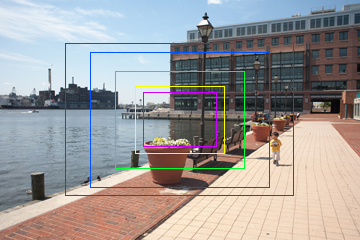
The entire image corresponds to the relative size of a "full frame" digital sensor such as the one in the Canon 5D. The red, blue, green, yellow, and purple lines correspond to the relative sizes of APS-C, 4/3", 1", 2/3", and 1/1.8" sensors respectively. The background image is there to illustrate the "crop factor," which is beyond the scope of my brief post here. The largest sensors in current, very compact cameras are around 1/1.7". Not too long ago, we had 2/3" sensors. Now, the next step up in sensor size from 1/1.7" (which would be between purple and yellow in the image above) is a huge leap to 4/3" (depicted above in blue). Comparing the smallest 4/3 system, the Olympus E-410 with kit lens, with DSLR systems based around the next step up in sensor size (APS-C) demonstrates the fact that smaller systems can be designed around smaller sensors. The, as of yet vaporware, Sigma DP1 promises a compact camera featuring an APS-C sensor. Likely this is possible in part since no mirror mechanism is incorporated, and in part because the DP1 features a prime lens of modest speed (f/4).
Why is there a leap from 1/1.7" to 4/3"? Surely a non-SLR digital camera with a 1" current-generation-technology sensor could be designed to be smaller than any DSLR + equivalent focal length range lens kit. Such a non-SLR camera would certainly provide better image quality and greater potential for shallow DOF than any current, smaller sensor compact digital cameras. The way I see it, these 1" sensor cameras could be made no larger than current "superzoom" cameras such as the Canon S5 IS or Olympus SP-550 by incorporating the tradeoff of a larger sensor and a more modest (2-3x) zoom range. Take, for example, my old Leica Digilux 2 (D2). The D2 could be made more compact today by 1) applying current generation design methods, and 2) making the lens non-fixed in length. The second of those two changes is not something I'd want, but it's worth mentioning that it could be done. In addition, one could presumably increase the D2 sensor size from 2/3" to 1" without increasing the overall size (largely determined by the lens size), if one were willing to accept a slower zoom, such as f/2.8-3.5 rather than f/2-2.4.
It makes no sense to me that we have only cameras with sensor sizes of 1/2.5", 1/1.8", 1/1.7", 4/3", 1.8" (APS-C), and 35mm. There is a large gap between 1/1.7" and 4/3" that is waiting to be plugged with 1" sensors. I am confident that bridge cameras derived from such sensors could be profitable in 2007 and beyond. Read More......
Posted by Amin
2
comments
Labels:
Bridge cameras,
digital camera,
sensor size
Subscribe to:
Posts (Atom)


