Mike Johnston, in his short publication "Lens Bokeh Ratings," states the following generalizations about bokeh (out-of-focus blur):
I’ve found as a general rule that bokeh gets progressively more problematic:
• the larger the aperture
• the closer the focus
• the more distant the background
• the more contrasty the background
I think that when we discuss which lenses produce nice OOF blur (bokeh) compared to those that don't, we too often compare lenses under the worst of circumstances. For example, here are two shots of my sons with the 50/1.4 under nearly the worst of circumstances (
Click on image for full size):


From these, one might conclude that the 50/1.4 harshly renders OOF blur (bokeh). This is far from true. Compare the OOF blur from the 50/1.4 at f/2.8-f/4 with any 50mm lens irrespective of price range, and it will compete well. Conversely, take the last generation pre-aspherical 35mm Summicron-M and shoot it wide open with a close subject and a distant, contrasty background. Even the so-called "King of Bokeh" will render a harsh OOF background blur under such circumstances.
Now see how the 50/1.4 renders an extremely challenging background at f/2.8:

Significant improvement. Now take a few moments to consider
William Castleman's bokeh comparison of the 50/1.2L and 50/1.4.
An interesting consequence of this effect of stopping down on the quality of bokeh - independent of the quantity of background blur - can be seen in
this bokeh comparison between the 35L on the 30D and 50/1.4 on the 5D.
Read More......

Not long ago, I posted the following:
"... my family recently moved from Baltimore City out to the Maryland suburbs, very close to this great park which is home (or hunting grounds) for a variety of wildlife including herons, beavers, swans, geese, and eagles. For the first time, I am tempted to get some equipment with true reach. Still not sure whether I should stay compact (eg. Panasonic FZ50) or think about carting around a long lens for the DSLR. If I weren't lugging around two small children with me, it would be a much easier decision!"
Shortly after that, I
posted, based on what turned out to be an incorrect source, that Panasonic would be announcing new cameras on July 17th. I was hopeful that the new Panasonic cameras would include an FZ50 replacement, but I think that what they instead introduced is an even better solution for me.
Today, Panasonic revealed the
DMC-FZ18. Amongst its many features, the ones which interest me the most are the following, some of which are unchanged from the FZ8:
- 18x f/2.8-4.2 zoom with focal length range equivalent to 28-504mm on a 35mm camera
- 8.1 MP 1/2.5" CCD sensor
- Image stabilization
- RAW + JPEG
- SD/SDHC storage
- Spot metering mode
- +/- 2 settings on NR, sat, contrast, sharpness (more control than FZ8)
- AE/AF lock
- Good EVF
The only other camera to include almost all of this is the Olympus SP-550, which has not gotten great reviews. It is clear that packing in this many features must come at the cost of certain compromises. However, Panasonic has consistently offered class-leading (IMHO) compact super-tele models, so I am confident that they made good compromises with this one.
Certainly this camera is in a different class than the FZ50, which is probably the finest currently-produced "bridge camera" available. I continue to look forward to what Panasonic has in store for the upgrade to that model. The FZ50 is more "DSLR-like" in both size and features, offering important advantages such as a larger sensor and mechanical zoom. If they keep the 1/1.8" sensor in the FZ50 replacement (assuming there is one) and extend the zoom range to 28-504mm equivalent, I'd have to imagine that there will be a size increase - or worse, a slower lens.
There are predictable downsides to this camera. Panasonic stuffed 8MP into a 1/2.5" sensor (24.7mm^2). By comparison, the FZ50 puts 10.1MP in a 1/1.8" sensor (38.2mm^2), a Canon 30D puts 8.2MP in a 337.5mm^2 sensor, and a Canon 5D puts 12.8MP in an 864mm^2 sensor. In terms of thousands of pixels per square mm then, they come out at roughly 324 (FZ18), 264 (FZ50), 24.3 (30D), and 14.8 (5D). With that little light hitting each pixel on the FZ18, it will inevitably be challenged in terms of dynamic range and noise, especially in low light conditions (see
here). Making things worse, Panasonic has a heavy-handed, detail smearing approach to noise reduction (NR) using their Venus III in-camera processing engine, have been known to apply NR to RAW files (see
here), and a very popular RAW processing engine has made heavy (IMO) NR mandatory for those who use it (see
here).
I can't imagine that such a small sensor camera will be any good for birds in flight, but I do think it will satisfy my very limited wildlife requirements. The FZ18 will be available in September at a retail price of $399.95, and I will be buying one of the first ones I can get my hands on. Early adopters do get burned sometimes. However, Panasonic has been consistently good in this class of cameras, and the main predictable downsides are compromises which I am prepared to accept.
Read More......
Interesting brief article here on modern lens history from the perspective of a Minolta user.
Was sad to read "Canon lenses don't have a 'look'," but I'd probably agree with that. While individual Canons may have a look, I really can't think of a look that applies to the entire brand as a whole. I guess that could be considered a good thing or not. Thoughts?
Read More......
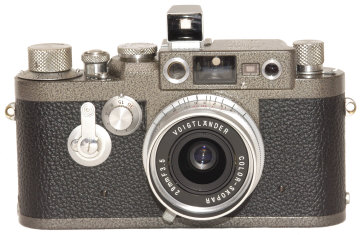
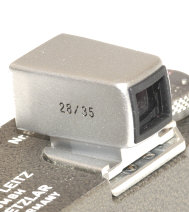
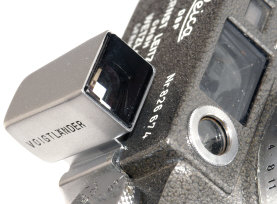
 All images used with permission, courtesy of CameraQuest.
The Cosina Voigtlander 28/35 Mini-Finder was introduced at PMA in 2004, came in chrome or black, and contains brightlines for 28 and 35mm which are visible at all times. From what I can tell, this model has been discontinued, and only the larger viewfinders are being made. However, one can still purchase this viewfinder here from CameraQuest. I bought mine a few days ago and received it yesterday. For my purposes, this viewfinder makes an excellent companion for the Ricoh GX100. It's far more compact than the Ricoh EVF and avoids the lag associated with the image reaching an EVF. It is very bright for its size, and the image seen is sharp. Eye relief is just acceptable. Wearing eyeglasses, I can make out the entire 28mm brightlines just barely. Framing via the Voigt Mini-Finder is in 3x2 aspect ratio, so in practice the vertical FOV is greater than that included within the brightlines, whereas the horizontal FOV is accurate. It hasn't taken me long to adjust for this issue. The major limitation, of course, is that the VF has guides only for 28 and 35mm, not 24, 50, or 72mm (the other focal length equivalents supported by the GX100 step zoom). However, 90% of my photos are at 28 or 35mm, so this works well for me. For the other focal lengths, I will either compose with the LCD or simply estimate using the OVF. One final consideration is that this finder blocks the GX100 popup flash. I hardly ever use this flash, so it won't bother me. However, since the the viewfinder has to be physically removed to use the on-board flash, it is certainly something to consider.
I did consider buying the Ricoh GV-1 OVF, which is made for the GRD. However, as the GV-1 is offset to match the location of the GRD lens, it won't match the midline position of the GX100 hot shoe relative to the lens. Furthermore, the GV-1 is rather large and lacks a brightline for 35mm.
Here are a couple more views of the CV 28/35 Mini-Finder, again used with permission from Stephen Gandy from CameraQuest.


If I get a chance, I'll update this post later with some images of the CV 28/35 Mini-Finder mounted on the GX100.
Read More......
I've expressed my disappointment in the lack of compact digital cameras offering excellent image quality on several occasions. As I pointed out here, much of it has to do with sensor size. In particular, as a long-time Canon user I have been disappointed in the lack of innovation from Canon in the compact segment.
Canon has announced that it is building a new $451 million factory to build CMOS chips. From the Reuter's article: "The CMOS chips will be used in both single lens reflex (SLR) models as well as in some compact models. Canon's compact cameras have to date used a different type of image sensor called a charge-coupled device (CCD)." A CMOS versus CCD technical discussion is beyond the scope of this brief. What is interesting is that Canon plans to take control of its own sensor production for some compact models as well as to use the same sensor technology in some compact models as they do in DSLRs.
It remains to be seen whether Canon is bringing some of it compact camera sensor production in-house just to cut costs or also so that they can improve image quality. Hopefully they can do both.
Read More......